
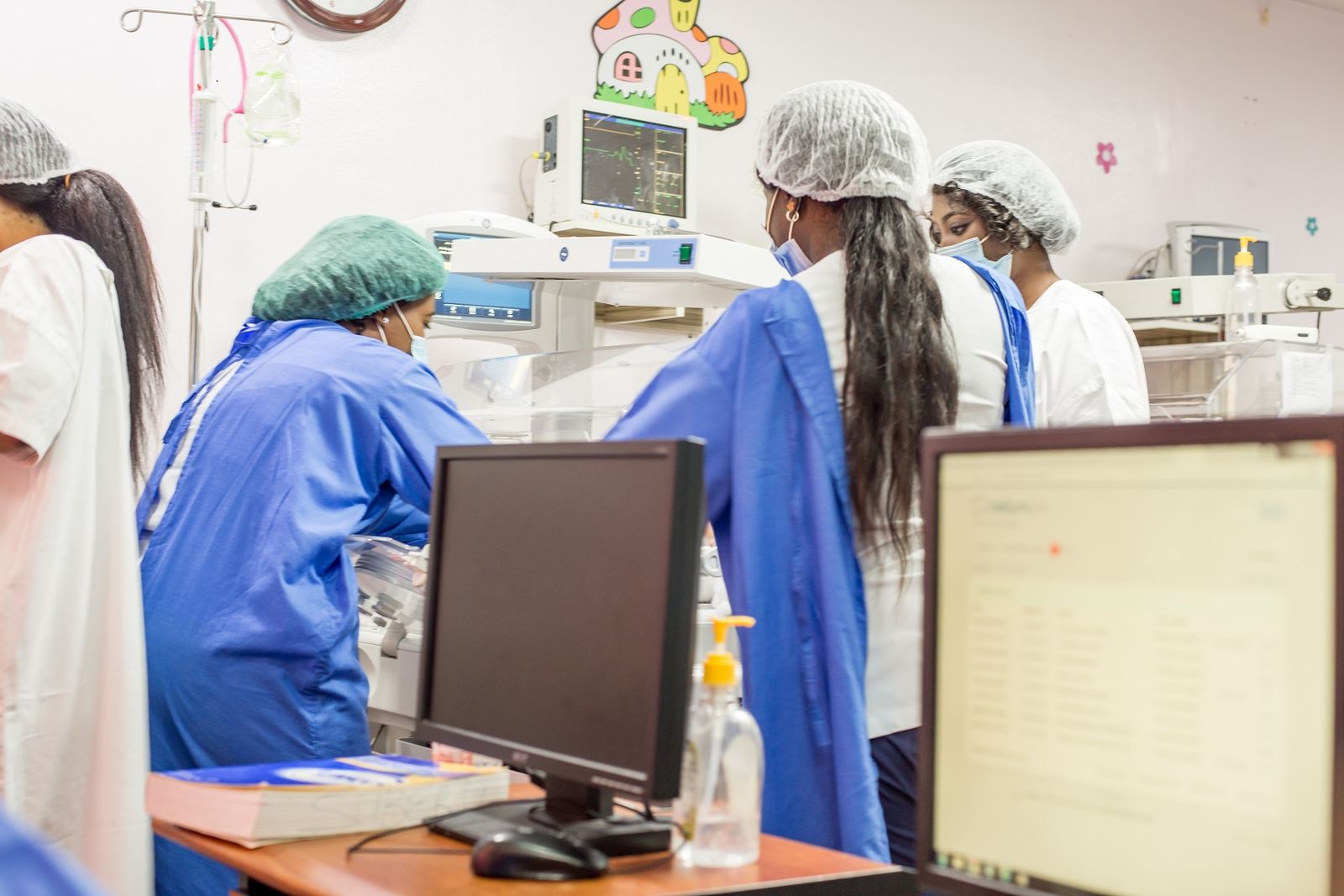
Our Promise to Referrers
You know the family, the history and the community the child goes home to. We keep you in the picture from the first call to the final report.
- We acknowledge. When you refer, we confirm we have the referral and tell you who in the team is taking it.
- We update. For a child who is admitted, we tell you the main findings and changes in the plan, with the family's consent.
- We report. When the assessment or admission is complete, you receive a written report: diagnosis, treatment given, results and the plan.
- We refer back. When specialist care is done, the child returns to you for ongoing care, with clear instructions for follow-up and what would need a return to us.
How to Refer a Child
Call first on 0813 408 5400 or 0809 059 9995 and say you are a health professional referring a child. For a routine outpatient referral, the family can also book through the online calendar and bring your letter to the first visit.
A letter that answers the questions below saves repeat tests and lets the team prepare before the child arrives. Handwritten is fine.
What to Put in a Referral Letter
The Child
The Story
The Request
Give the family a copy of the letter and any results to bring, and tell them about HMO or NHIA authorisation where it applies. Families can read what to bring and how approvals work before they come.
Newborn and Critical Transfer
Call before transfer so our team can prepare. When you call before the baby or child leaves you, the team advises on stabilisation, confirms the child can be received, and has the right people and equipment waiting. A transport incubator for newborn transfer is arranged case by case, when one is available and the transfer is clinically arranged: ask when you call.
Most harm in transfer happens when a child leaves before they are stable, or arrives cold, hypoglycaemic or without information. The card below sets out the core steps from WHO guidance on newborn and emergency care and from neonatal transport guidance. Adapt it to your training, your equipment and your local protocols.
Transfer Card: Before the Child Leaves You
- Call first. 0813 408 5400 or 0809 059 9995. Give age, weight, the problem, observations and treatment so far. Agree the plan and the timing.
- Airway and breathing. Clear and position the airway. Give oxygen if the child is hypoxic and you have it. Note the breathing rate, work of breathing and oxygen saturation, with times.
- Circulation. Note heart rate, capillary refill and colour. Treat shock according to your protocol before moving.
- Temperature and warmth. Check it. Keep a newborn warm: skin to skin on the mother or another adult, or dried, wrapped and with the head covered. Prevent heat loss all the way.
- Glucose. Check the blood glucose if you can. Prevent and treat low glucose according to your protocol: a feed if the baby can feed safely, or intravenous glucose if that is within your training.
- Intravenous access, where trained. Secure a cannula before leaving if the child is likely to need fluids or medicines on the way. Do not delay a critical transfer for repeated attempts.
- Documentation. Send the referral letter, observation chart and every medicine given with the time. For a newborn: gestation, birth weight, Apgar scores, resuscitation, rupture of membranes, maternal fever and antenatal steroids.
- Mother's details and samples. Send the mother's name, blood group and infection screening results. If relevant, send a sample of maternal blood and any expressed breast milk, labelled, and encourage the mother to come or to follow as soon as she safely can.
- An escort and the family. A trained person travels with the child to watch breathing, colour and warmth. Explain to the family what is happening and why.
For a critically ill older child, the same principles apply: call, stabilise airway, breathing and circulation, treat seizures and low glucose, keep the child warm, document, and send an escort. If the child deteriorates on the way and you cannot reach Limi quickly, go to the nearest emergency department.
Our newborn care and NICU page describes what happens after a newborn arrives, and emergency and intensive care covers older children.
Referring a Baby with a Birth Defect
Some babies are born with a difference in the structure or function of the body: a heart defect, a cleft lip or palate, a neural tube defect, an abdominal wall defect, a limb difference, a blocked bowel or anus, or a genetic condition such as Down syndrome. Many can be treated. Outcomes depend heavily on early recognition, careful first handling and prompt specialist care.
Every facility that cares for newborns should recognise, document and report birth defects, as set out in the WHO, CDC and ICBDSR birth defects surveillance manual and in national reporting requirements. We follow these steps, and bring together under one roof the specialties these babies need.
- Recognise. A full newborn examination, head to toe, before the baby goes home: face, palate, spine, limbs, genitalia, anus, heart sounds, breathing and colour. Some heart defects show only as fast breathing, poor feeding or a low oxygen saturation.
- Protect and stabilise. Keep the baby warm, and check glucose and oxygen. Cover an exposed defect such as an open spine or abdominal wall with clean, moist, non-stick dressing and plastic wrap. Do not feed a baby with vomiting, a swollen abdomen or no passage of stool; call.
- Document. Describe what you see and when it was noticed, with the pregnancy history, maternal medicines and illnesses, and family history. Photographs are useful for the specialist, taken only with the parents' consent and shared securely.
- Call and refer. The team advises on urgency when you call. The neonatal, heart (cardiology, with heart scans or echocardiography), surgical, therapy and developmental teams plan the baby's care together, around one baby rather than separate clinics. When a baby needs care that another centre provides, we say so and help arrange it.
- Support the family. Parents are told plainly what is known, what is not yet known, and what the next steps are. A birth defect is no one's fault, and saying so matters.
- Report and refer back. Cases are documented for surveillance as national reporting requires, and you receive a report and a plan for shared follow-up.
Maternity Centres, PHCs and Hospitals: Agree a Referral Route
If you care for mothers and newborns, agree your route for babies with birth defects before you need it: who to call, what to send and how you hear back. Call 0813 408 5400 and ask for the team that handles birth defect referrals.
Services You Can Refer To
| Area | Includes |
|---|---|
| Newborn | NICU, neonatology, neonatal transfer support, prematurity follow-up, jaundice |
| Emergency and critical care | Emergency assessment day and night, inpatient wards, PICU |
| Surgery | General paediatric surgery, urology, orthopaedics |
| Heart | Paediatric cardiology and echocardiography |
| Specialist clinics | Nephrology, neurology, haematology, endocrinology, pulmonology, ENT, gastroenterology, dermatology |
| Development | Developmental clinics, autism assessment, speech therapy, physiotherapy |
| Everyday care | General paediatrics, immunisation, nutrition, adolescent care, dentistry, 24-hour laboratory, imaging |
| Pregnancy | Non-invasive prenatal testing (NIPT) |
Limi Paediatric Practice Updates
Every month, LCH runs an online session for doctors, nurses, midwives, pharmacists and allied professionals. Each one is case-led: a common problem seen in clinics, PHCs, pharmacies and emergency rooms across Nigeria, the current evidence, and the decisions that change what happens to the child, including when to refer.
A Recent Topic: Beyond Anaemia, the Heart in Childhood Sickle Cell Disease
How sickle cell disease affects the heart and lungs in childhood, what to look for at routine review, and when a child needs a heart scan or specialist assessment.
Dates and topics are announced per session, with a registration link for each. To hear about the next session, follow the hospital on YouTube or Instagram, or call and ask for the date.
Abuja Perinatal Symposium
Each year LCH hosts the Abuja Perinatal Symposium for the professionals who care for mothers and newborns: paediatricians, neonatologists, obstetricians, nurses, midwives and trainees. More than 300 attended the fourth edition in 2025. About the symposium.
HMOs, Schools and Organisations
HMOs, employers, schools and crèches: to discuss care for your members, staff or pupils, call 0813 408 5400. Schools can also read about first aid, health checks and training for schools.
Sources for the Transfer Card and Birth Defects Referral
- World Health Organization. Paediatric emergency triage, assessment and treatment: care of critically-ill children. Updated guideline. 2016.
- World Health Organization. Pocket book of hospital care for children. 2nd edition, 2013.
- World Health Organization. WHO recommendations for care of the preterm or low-birth-weight infant. 2022.
- American Academy of Pediatrics. Guidelines for Air and Ground Transport of Neonatal and Pediatric Patients. 4th edition, 2016.
- World Health Organization, CDC and ICBDSR. Birth defects surveillance: a manual for programme managers. 2nd edition, 2020.