
If You Remember Nothing Else
- How your child looks matters more than the number. A child with 39.5 °C who is playing is usually less worrying than a child with 38.2 °C who is floppy.
- Under 3 months, 38 °C or more always needs to be seen now.
- In Nigeria, every fever needs a malaria test — and malaria medicine only after a positive test.
- Give drinks, dress lightly, and use paracetamol or ibuprofen only for comfort, at the dose on the pack.
- Never sponge with cold water or wrap a feverish child in blankets.
- A fever lasting three days or more, or one that keeps coming back, needs a doctor to find the cause.
What Counts as a Fever
A normal temperature under the arm is about 36.5 to 37.5 °C, and it rises a little in the evening, after play, and in the Abuja heat. A fever is 38 °C or more. Between 37.5 and 38 is slightly raised — worth checking again in half an hour, not worth worrying about on its own.
Fever is not an illness. It is the body turning up its thermostat to fight an infection, and in most children the infection is a virus that clears in two or three days. The height of the temperature does not tell you how serious the infection is — a mild virus can give 40 °C, and a serious infection can give 38. That is why the checker asks about how your child looks and behaves, not just the number.
How to Take a Temperature
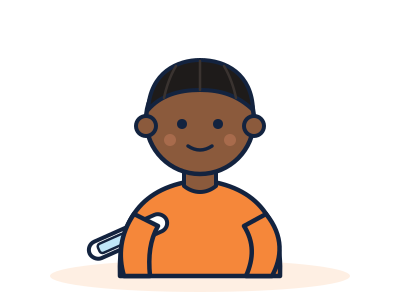
- Use a digital thermometer. They cost little at any pharmacy. Glass mercury thermometers are dangerous if they break, and forehead strips are not accurate.
- For babies and young children, measure under the arm. Put the tip in the middle of the armpit, touching skin, and hold the arm gently against the side.
- Wait for the beep, then write down the number and the time. Our symptom diary keeps the list for you, ready to show the doctor.
- Do not measure straight after a bath, a meal or a run around. Wait 15 minutes.
- No thermometer? Feeling the back of the neck or the tummy is better than the forehead, but it is a guess. Treat a child who feels hot and looks unwell as having a fever.
Caring for a Fever at Home
When the checker says your child can be cared for at home, these four things help.
Drinks, Little and Often
Fever makes children lose water through their skin and breath. Keep breastfeeding, more often than usual. For older children, offer water, ORS, diluted fruit juice or pap regularly, even if they only take a few sips. Look for a wet nappy or a wee at least every 6 to 8 hours — fewer means they need more to drink. None for 8 hours means see a doctor today; none for 12 hours means come in now.
Light Clothing, a Comfortable Room
Dress your child in one light layer and let air move around them. Do not wrap a shivering child in blankets: it traps heat and can push the temperature higher. If they are shivering, a light cloth is enough.
Medicine for Comfort
Paracetamol or ibuprofen can make a miserable child feel better so they drink and sleep. They do not cure the infection, they do not prevent fits, and there is no need to wake a sleeping child to give them.
- Use the dose on the pack for your child's age, measured with the syringe or spoon that comes with it — not a kitchen spoon.
- Check the strength on the label; syrups come in different strengths.
- Do not give both medicines at the same time, and do not alternate them, unless a doctor has told you to.
- Do not give ibuprofen to a child who is dehydrated, has asthma that gets worse with it, or has chickenpox.
- Never give aspirin to anyone under 16.
- Do not give any medicine to a baby under 3 months without a doctor's advice.
Rest, and Keep Checking
Children with a fever often want to lie down and are off their food for a day or two. That is fine as long as they drink. Check on them during the night — look at their colour, breathing and how easily they wake.
Fever and Malaria
In Nigeria, malaria is common enough that every child with a fever needs a malaria test. The test is a finger-prick of blood: a rapid diagnostic test takes about 15 minutes, and a blood film is read under a microscope. Limi Children's Hospital runs a 24-hour diagnostic laboratory. Treat malaria only when a test is positive, with a full course of the medicine a health worker prescribes.
If a test is negative, the fever has another cause, and more malaria medicine will not help. Many "fevers that keep coming back after malaria treatment" turn out never to have been malaria at all — a urine infection, a chest infection, a virus, or occasionally something that needs more tests. Read our full guide to malaria in children.
Come In Now
Any age, with a fever and
- a baby under 3 months with 38 °C or more
- a fit, or drowsy and hard to wake
- unable to drink or vomiting everything
- breathing difficulty
- very pale, yellow eyes or dark urine
- sickle cell disease
See a Doctor Today
Same day
- Any baby 3 to 6 months at 39 °C or more
- Fever for 3 days or more
- Fever back after malaria treatment
- Signs of a urine, ear or chest infection
At Home
With a malaria test
- Drinking, weeing and waking normally
- Playful when the temperature comes down
- Fever for less than 3 days
- You feel confident to watch
Fits with a Fever (Febrile Seizures)
About 1 in 30 children between six months and five years has a fit with a fever at some point. It is frightening to watch — the child goes stiff, then jerks, may roll their eyes and not respond — but a simple febrile seizure stops by itself within a few minutes and does not cause brain damage.
- Stay calm and time it. Note when it started.
- Lay your child on their side on the floor, away from anything hard or sharp.
- Put nothing in their mouth — not a spoon, not your fingers, not water, not onions or palm oil. They cannot swallow their tongue.
- Do not hold them down, shake them or put them in water.
- When the jerking stops, keep them on their side until they wake properly.
Go to Emergency Care Now If
it is your child's first fit; it lasts more than 5 minutes; it happens again within 24 hours; only one side of the body jerks; or your child does not wake up normally within an hour. Every child who has had a first fit with a fever needs an examination to find the cause of the fever. See the first aid guide to fits.
What Does Not Help
Sponging or bathing in cold water to bring the temperature down.
Cold water makes the skin's blood vessels clamp down and the child shiver, which can raise the core temperature and makes them miserable. Light clothing and drinks work better.
Wrapping the child up to "sweat the fever out".
Wrapping traps heat. One light layer is right, even at night.
Starting malaria medicine, or an injection, as soon as there is a fever.
Test first. Treating without testing misses the real cause and wastes medicine that should work when it is really needed.
Giving antibiotics left over from last time, or bought from a chemist.
Most fevers are viral, and antibiotics do nothing for viruses. The wrong antibiotic can also hide the signs of a serious infection. Only give antibiotics a health worker has prescribed for this illness.
A very high fever will damage the brain.
Fever from an infection does not damage the brain. The infection causing it is what matters — which is why how the child looks is so important.
Questions Parents Ask
Can teething cause a fever?
Teething can make a baby slightly warm and grumpy, but it does not cause a temperature of 38 °C or more. A real fever in a teething baby has another cause: treat it like any other fever. See our guide to teeth and teething.
The fever is always worse at night. Why?
Body temperature naturally rises in the evening, so fevers often peak then. It does not by itself mean your child is getting worse. Look at how they breathe, wake and drink.
The medicine did not bring the temperature down. Is that serious?
Not on its own. Whether a fever comes down with medicine does not tell you how serious the illness is. What matters is how your child looks and behaves, and the signs in the checker above.
When can my child go back to school or crèche?
When they have had no fever for 24 hours without medicine and feel well enough to join in. This protects other children, too.
My baby has a fever after vaccines. Is that normal?
A mild fever within 48 hours of vaccines is common, especially after pentavalent and PCV injections, and settles within a day or two. A temperature of 38 °C or more in a baby under 3 months needs to be seen now, even after vaccines. A fever of 39 °C or more, one lasting more than 48 hours, or a child who seems unwell should be checked the same day.
We have just come back from the village. Does that matter?
Tell the doctor where you have travelled. Malaria, Lassa fever in some states, and other infections depend on where you have been, and the doctor chooses the tests to match.
Sources
- National Institute for Health and Care Excellence. Fever in under 5s: assessment and initial management (NG143). 2019, updated 2021.
- World Health Organization. WHO guidelines for malaria. 2023 and later updates.
- World Health Organization. Pocket book of hospital care for children, 2nd edition. 2013.
- National Malaria Elimination Programme, Nigeria. National guidelines for diagnosis and treatment of malaria.
- American Academy of Pediatrics. Febrile seizures: guideline for the neurodiagnostic evaluation of the child with a simple febrile seizure. Pediatrics, 2011.
Written for parents and carers in NigeriaClinically reviewed by Limi Children’s Hospital cliniciansLast updated September 2026Next review due September 2027