
Do Not Count — Come In Now — If Your Child
has blue or grey lips, cannot speak or feed because of breathlessness, stops breathing for more than 20 seconds, is grunting with every breath, or is very drowsy. Come to Limi Children's Hospital now, day or night. If you cannot get here quickly, go to the nearest emergency department. Have someone else drive if you can, so you can watch your child, and call 0813 408 5400 on the way so the team can prepare.
The Breathing Counter
Count while your child is calm or asleep — crying and feeding make breathing faster.
Press once to start the clock, then tap each time the chest or tummy rises. The count stops by itself after 60 seconds.
Fast-breathing thresholds from the WHO Integrated Management of Childhood Illness. For children over 5, count and look for the signs above, and ask a clinician what is normal for their age.
If You Remember Nothing Else
- Count for a full 60 seconds, while your child is calm, with the chest uncovered.
- Fast breathing is 60 or more under 2 months, 50 or more from 2 to 11 months, 40 or more from 1 to 5 years. See a doctor today. Fast breathing in a baby under 2 months, or 60 or more at any age, means come in now.
- Skin sucking in below the ribs is a danger sign at any age, even if the count is normal.
- Blue lips, grunting with every breath, or too breathless to feed — go now, do not count.
- Pneumonia needs a doctor's examination, not cough syrup or leftover antibiotics.
How to Count Well
- Wait until your child is calm. Asleep is ideal. A crying, feeding or feverish child breathes faster; if they have a fever, count again when it has come down.
- Lift the clothes so you can see the chest and tummy. In babies, the tummy moves more than the chest.
- One rise and fall is one breath. Tap once each time the tummy rises.
- Count for the full minute. Babies breathe irregularly, with short pauses, so counting for 15 seconds and multiplying gives the wrong answer.
- If the number is borderline, count again a few minutes later. Two fast counts mean the breathing is fast.
| Age | Fast breathing is | Usual range when calm |
|---|---|---|
| Under 2 months | 60 or more a minute | about 30 to 55 |
| 2 to 11 months | 50 or more a minute | about 25 to 45 |
| 1 to 5 years | 40 or more a minute | about 20 to 35 |
Signs a Child Is Working Hard to Breathe
The count is one sign. The other is effort: a child with a lung infection, asthma or bronchiolitis (an infection of the small airways) uses extra muscles to breathe, and you can see it.
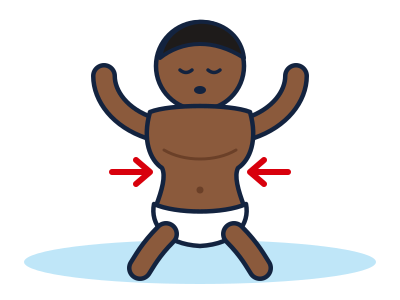
- Chest indrawing. The skin below the ribs, between the ribs or above the collarbone sucks in with each breath. This is the sign doctors look for first, and it means your child needs to be seen now.
- Nostril flaring. The nostrils widen with each breath.
- Grunting. A short sound at the end of each breath out. In a newborn, this is a sign of real difficulty.
- Head bobbing. In babies, the head nods with each breath as the neck muscles help.
- Colour. Blue or grey lips and tongue mean not enough oxygen. On darker skin, look at the lips, tongue, gums and nail beds.
- Feeding and talking. A baby who stops feeding to breathe, or a child who cannot finish a sentence, is too breathless.
Noises and What They Mean
- Snuffly, blocked nose
- Very common in babies, whose noses are small. Saline drops before feeds help. Not a sign of a chest problem on its own.
- Wheeze
- A whistling sound breathing out. Common with viral infections in babies (bronchiolitis) and with asthma. Needs to be seen if new, or if your child is working hard.
- Stridor
- A harsh, high sound breathing in, often with a barking cough — croup. Come in now if it happens while your child is calm, not just crying.
- Grunting
- A short noise at the end of each breath out. A sign of real difficulty, especially in babies. Come in now.
- Rattly chest
- Mucus in the throat or big airways, common with colds. Usually harmless if breathing is not fast and the child is feeding.
- Snoring with pauses
- Loud snoring, gasping or pauses in sleep can mean large tonsils or adenoids. Book a visit; it is not an emergency.
Common Causes of Fast or Difficult Breathing
- Pneumonia — an infection in the lungs, often with fever and cough. Worldwide, it causes more deaths in young children than any other infection, and it is very treatable when caught early. Coughs, colds and pneumonia.
- Bronchiolitis — a viral infection of the small airways in babies under 1, with cough, wheeze and difficulty feeding. Most babies recover at home; some need oxygen or feeding help in hospital.
- Asthma — wheeze and breathlessness that come and go, often with colds, dust or exercise. Asthma in children.
- Fever and dehydration — both make children breathe faster. Count again when the fever is down.
- Severe malaria and anaemia — deep, fast breathing can be a sign of serious illness. Come in now.
- Something inhaled — sudden coughing and breathing difficulty after playing with small objects or food. See choking.
Questions Parents Ask
Should I buy a pulse oximeter?
No. Finger oximeters sold for adults are often inaccurate on small children and can give false reassurance. Your eyes are a better guide: the count, the signs of working hard, and how your child is feeding and behaving.
My baby breathes fast, then stops for a few seconds, while asleep. Is that normal?
Yes, in newborns. It is called periodic breathing: bursts of fast breathing with pauses of up to 10 seconds. Pauses of 20 seconds or more, or any pause with colour change, need to be seen now.
Can I give cough syrup for fast breathing?
No. Cough and cold medicines are not recommended for children under 6 and do not treat pneumonia or asthma. Fast breathing needs an examination.
Does steam or a vapour rub help?
Steam from a bowl of hot water has caused serious scalds in children and does not help croup or pneumonia. Menthol rubs should not be used on babies, or near any child's nose and mouth.
Can smoke at home make it worse?
Yes. Cigarette smoke, cooking with firewood or kerosene indoors, burning rubbish and generator fumes all irritate children's lungs and make chest infections and asthma more likely. Keep children away from smoke, and never run a generator indoors or near a window.
Sources
- World Health Organization. Integrated Management of Childhood Illness: chart booklet. 2014.
- World Health Organization. Revised WHO classification and treatment of pneumonia in children at health facilities. 2014.
- National Institute for Health and Care Excellence. Bronchiolitis in children: diagnosis and management (NG9). Updated 2021.
- UNICEF. Pneumonia. UNICEF Data: child health.
Written for parents and carers in NigeriaClinically reviewed by Limi Children’s Hospital cliniciansLast updated September 2026Next review due September 2027