
If You Remember Nothing Else
- Yellow skin or eyes in the first 24 hours of life is never normal. Come in now for a bilirubin test.
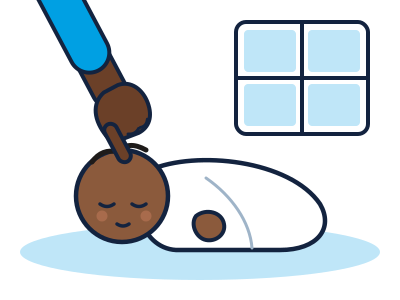
- Check in daylight by pressing the skin. Look at the whites of the eyes, the gums and the colour of pressed skin, working from head to toe.
- Yellow spreading to the tummy or legs needs a test today. Yellow palms or soles, or a yellow baby who is very sleepy or not feeding, means come in now.
- Pale, white or clay-coloured stools, or dark urine, need a doctor today. They can be the sign of a liver problem that needs an operation early.
- Still yellow at 2 weeks (3 weeks if born early)? Your baby needs a check and a blood test, even if they seem well.
- Sunlight, glucose water and herbal mixtures do not treat jaundice. Keep breastfeeding often. Keep camphor balls and menthol away from your baby.
When to Act
Jaundice is the yellow colour that comes from a substance called bilirubin building up in the blood. Around six in ten babies born at full term and eight in ten babies born early become visibly yellow in the first week. For most, it is harmless. What matters is telling the ordinary kind from the kind that needs treatment. That depends on when it started, how far it has spread, how the baby is feeding and behaving, and how the baby's stools look.
Come In Now
Emergency department, straight away
- Yellow skin or eyes in the first 24 hours of life
- Yellow palms or soles, at any age
- A yellow baby who is very sleepy, hard to wake or will not feed
- A yellow baby who is floppy, or stiff with the neck or back arched
- A high-pitched cry that is not like your baby's usual cry
- A fit: stiffening, jerking or staring spells
- Temperature 38 °C or more, or below 35.5 °C
See a Doctor Today
Same day, not tomorrow
- Yellow that has spread below the tummy button, or to the arms and legs
- Yellow getting deeper day by day, or any yellow in a baby born before 37 weeks
- Pale, white, grey or clay-coloured stools
- Dark urine that stains the nappy yellow or brown
- Fewer than 6 wet nappies a day after day 5, or feeding less
- Still yellow at 2 weeks (3 weeks if premature)
- An older brother or sister needed light treatment for jaundice
Usually Normal
Keep feeding often and mention it at the next check
- Mild yellow of the face and eyes starting on day 2 or 3
- A baby who wakes for feeds and feeds 8 to 12 times a day
- Plenty of wet nappies and yellow, seedy stools
- Yellow that stays on the face and chest and is fading by the end of week one
How to Check Your Baby at Home
Jaundice starts in the face and moves down the body as the level of bilirubin rises. You can use that to see roughly how far it has gone. On brown and dark skin the yellow can be hard to see directly, so look at the places where the underlying colour shows through.
- Go to a window in daylight. Room bulbs and yellow-tinted lights make every baby look yellow, or hide it. Check in natural light, but do not leave the baby lying in the sun.
- Look at the whites of the eyes and the gums. Gently lift the upper lip. Yellow here is often the easiest sign to see on darker skin.
- Press a fingertip on the skin for a second, then lift it. Start on the forehead or nose. Pressing pushes the blood away, so the skin underneath shows its true colour. If it looks yellow as your finger lifts, the jaundice has reached that level.
- Work down the body. Press on the chest, then the tummy below the belly button, then the thighs and lower legs, and finally the palms and soles.
- Check the nappy. Normal newborn stools after the first few days are yellow, mustard or green. Urine should be pale and almost colourless.
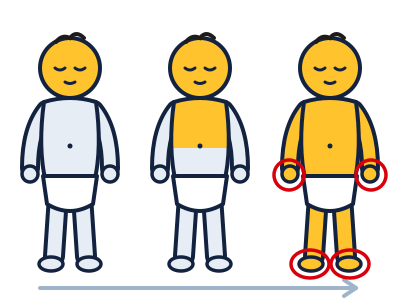
This check tells you when to get your baby tested. It cannot tell you that your baby is safe: the eye is poor at judging bilirubin, especially on darker skin, which is why nurses and doctors use a meter or blood test. If you are unsure, get your baby checked.
Why Yellow in the First 24 Hours Is Different
Ordinary newborn jaundice takes a day or two to appear. Yellow in the first 24 hours usually means bilirubin is rising fast, most often because the baby's red blood cells are being broken down too quickly. Common reasons are a difference between the mother's and baby's blood groups (rhesus or ABO incompatibility), G6PD deficiency, or an infection. The level can climb within hours to the point where it can damage the brain.
Guidance from NICE says a baby visibly yellow in the first 24 hours should have bilirubin measured within two hours. If you notice it at home, or after an early discharge from a clinic, do not wait for the next check-up. Come to Limi Children's Hospital now, day or night, where the team can test your baby's bilirubin. If you cannot get here quickly, go to the nearest emergency department.
Why Newborns Go Yellow
Before birth, a baby needs extra red blood cells to carry oxygen. After birth these extra cells are broken down, which releases bilirubin. The newborn liver is still learning to clear it, so for a week or two bilirubin builds up faster than it leaves. This is physiological jaundice: it appears on day two or three, peaks around day three to five, and fades by about two weeks.
Some babies are more likely to develop higher levels:
- Born before 38 weeks, with a less mature liver.
- Not yet feeding well, because bilirubin leaves the body in the stools.
- Bruising from a difficult birth, such as a large swelling on the head.
- A brother or sister who needed treatment for jaundice.
- A blood group difference from the mother, especially a rhesus-negative mother, or a group O mother with an A or B baby.
- G6PD deficiency, which is common in Nigeria.
G6PD Deficiency: Why It Matters in Nigeria
G6PD is an enzyme that protects red blood cells. Many families in Nigeria carry a gene that means the body makes less of it. It is passed down on the X chromosome, so it is more common and usually more marked in boys, although girls can be affected too. Most people with G6PD deficiency are healthy most of the time. In newborns, it is one of the most common reasons for jaundice that rises high and fast.
Certain things can trigger a sudden breakdown of red cells in a baby with G6PD deficiency. Some of them are found in many Nigerian homes:
- Camphor or naphthalene balls ("mothballs") stored with baby clothes and wrappers. The vapour is absorbed through the skin and lungs.
- Menthol in some dusting powders, balms and rubs.
- Some herbal mixtures given to the baby, or taken by a breastfeeding mother.
- Some medicines, including certain antimalarials and antibiotics. A doctor who knows about the G6PD result will choose medicines that are safe.
- Infections, which is one more reason a sick yellow baby needs to be seen.
Wash new baby clothes and air them in the shade before use, and keep camphor balls out of any wardrobe or box where the baby's things are kept. When a baby is jaundiced, the team decides whether a G6PD test is needed. If the result shows deficiency, ask for a written note of it for the child health card. It matters for the rest of your child's life.
Breastfeeding and Jaundice
Breast milk does not cause harmful jaundice, and stopping breastfeeding is almost never the answer. There are two connections parents hear about:
- Not getting enough milk in the first days. If a baby is not feeding well, fewer stools pass and more bilirubin is absorbed back into the blood. Frequent feeding helps. Offer the breast 8 to 12 times in 24 hours, wake a sleepy baby for feeds at least every 3 hours in the first days, and ask for help early if the latch hurts or the baby is not swallowing. See our breastfeeding guide.
- Breast milk jaundice. Some healthy breastfed babies stay a little yellow for several weeks. They feed well, gain weight, and have yellow stools and pale urine. This is harmless, but it can only be called breast milk jaundice after tests have ruled out other causes — so a baby still yellow at two weeks still needs a check.
Jaundice That Lasts Beyond Two Weeks
Jaundice is called prolonged if a baby is still yellow after 14 days (or 21 days for a baby born before 37 weeks). Most of these babies are well and have breast milk jaundice. A small number have an underactive thyroid, a urine infection, a blood condition or a liver problem. The only way to tell is to examine the baby, look at the stools and urine, and do a blood test that measures the two types of bilirubin (a "split" or conjugated bilirubin).
If your baby is still yellow at two weeks, see a doctor — today if you can, and no later than the next day; the same day if the stools are pale or the urine is dark. Do not wait for the six-week visit, and do not accept "it is just breast milk" without the blood test.
Pale Stools and Dark Urine: The Sign Not to Miss
If a yellow baby has pale stools or dark urine, bilirubin may not be getting out of the liver into the gut. One important cause is biliary atresia, where the tubes that carry bile out of the liver are blocked or missing. It is rare, but treatable with an operation (the Kasai procedure), and the operation works better the earlier it is done — ideally before the baby is about eight weeks old. Every week of delay matters.
Some countries give parents a stool colour card to compare nappies against. You can do the same with this picture.
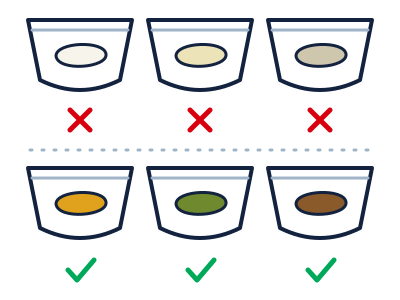
Photograph any nappy that worries you, in daylight, to show the doctor. Newborn urine should be pale; urine that stains the nappy yellow or brown needs checking too.
Tests and Treatment in Hospital
Measuring Bilirubin
A skin meter (transcutaneous bilirubinometer) pressed lightly on the forehead or chest gives a quick estimate without a needle. If the reading is high, or the baby is very young or unwell, a blood test from a heel prick or vein gives the exact level. The result is plotted on a chart against the baby's age in hours and weeks of pregnancy at birth. The same number can be fine at four days and dangerous at one day, which is why the team asks exactly when your baby was born.
Depending on the timing, the team also checks the baby's blood group and the mother's, a test for antibodies (the Coombs or DAT test), a full blood count, G6PD, and signs of infection.
Phototherapy (Light Treatment)
Phototherapy is the usual treatment. The baby lies in a cot or incubator under a special blue light, wearing only a nappy, with soft pads over the eyes. The light changes bilirubin in the skin into a form the body can pass out in the urine and stools. It does not hurt. You can usually keep breastfeeding, with short breaks from the light for feeds and nappy changes unless the level is very high. The stools may become looser and greener; this is expected.
Bilirubin is checked again during treatment, often several times on the first day. The light is stopped once the level has fallen safely, and many babies have one more test after that to make sure it has not risen again.
Exchange Transfusion
If bilirubin is very high, rising fast despite phototherapy, or the baby shows signs that it is affecting the brain, the team recommends an exchange transfusion. Small amounts of the baby's blood are removed and replaced with donor blood, a little at a time, through a thin tube, usually in the cord. This lowers bilirubin quickly and removes antibodies that are breaking down red cells. It is done in a neonatal unit with close monitoring, after the team has explained the benefits and risks and you have given consent.
Limi's neonatal team treats jaundiced babies day and night, including in the neonatal intensive care unit (NICU), backed by a 24-hour diagnostic laboratory. If you are a health worker arranging a transfer for a jaundiced baby, call before transfer so our team can prepare, and see newborn transfer.
When Jaundice Affects the Brain
At very high levels, bilirubin can pass into the brain. This is called acute bilirubin encephalopathy, and the lasting damage it can cause is called kernicterus: problems with movement (a type of cerebral palsy), hearing loss, and problems with the teeth and eye movements. It happens when high jaundice is not recognised or treated in time. It is preventable: test early and treat early.
The early signs are easy to mistake for a "good, quiet baby":
- becoming very sleepy, hard to wake, and not interested in feeding
- feeling floppy
- then becoming irritable, with a shrill, high-pitched cry
- stiffness, with the head and neck pulled back or the back arched
- fever, or fits
Any of these in a yellow baby means come to Limi Children's Hospital now, day or night. If you cannot get here quickly, go to the nearest emergency department. Have someone else drive if you can, so you can watch your baby, and call 0813 408 5400 on the way so the team can prepare.
Remedies to Avoid
Some well-meant advice about jaundice delays the test that shows whether treatment is needed.
Put the baby in the morning sun to clear the yellow.
Ordinary sunlight is not a reliable treatment. It cannot tell you whether the level is dangerous, and it can burn or overheat a newborn and dehydrate them. Researchers in Nigeria have tested specially filtered sunlight canopies, but only under medical supervision with regular blood tests. That is different from sunning a baby at home.
Give glucose water, plain water or a herbal mixture (agbo) to "wash out" the jaundice.
None of these lowers bilirubin. They reduce how much milk the baby takes, and some herbal mixtures can trigger red cell breakdown in G6PD deficiency or harm the liver. Breastfeed often instead.
Every baby has jaundice; there is no need to test.
Many babies are yellow, but a few have levels high enough to harm the brain, and you cannot tell which by looking. A quick test is how you know.
Questions Parents Ask
Only the whites of my baby's eyes are yellow. Is that jaundice?
Yes. On darker skin, the eyes and gums are often the first place yellow shows. If it started after the first day and your baby is feeding well, it is probably the ordinary kind — but press the skin down the body in daylight, and ask for a skin or blood test at the next check, or today if it is spreading.
Is phototherapy safe? Will the light hurt my baby's eyes?
Phototherapy has been used for decades and is safe when it is supervised. The eye pads protect the eyes from the bright light, the nurses check the baby's temperature and fluids, and the light is stopped as soon as the level is safe. It is not the same as sunlight and does not burn the skin.
Can we go home while the baby is still yellow?
Often, yes. Many babies go home with some yellow still showing, once the level is falling or below the treatment line for their age. Ask when the next bilirubin test should be, what the level was, and what signs should bring you back.
The jaundice went away, then came back. Why?
Bilirubin can rise again after phototherapy stops (a "rebound"), especially in babies with G6PD deficiency or blood group differences. A baby who looks yellow again, or more yellow, needs another test the same day.
Will my next baby have jaundice too?
Not necessarily, but a baby whose brother or sister needed phototherapy is more likely to need it too. If you are rhesus negative, make sure your antenatal team knows, as an injection in pregnancy can protect future babies. Tell the team caring for your next baby about any previous jaundice.
Should my baby be tested for G6PD?
Testing matters most if your baby has jaundice that needs treatment, if a brother or sister had severe jaundice, or if G6PD deficiency is known in the family. Ask your baby's doctor. The result helps doctors choose safe medicines later in life.
Sources
- National Institute for Health and Care Excellence. Jaundice in newborn babies under 28 days (CG98). 2010, updated 2023.
- Kemper AR and others, American Academy of Pediatrics. Clinical practice guideline revision: management of hyperbilirubinemia in the newborn infant 35 or more weeks of gestation. Pediatrics, 2022.
- World Health Organization. WHO recommendations on maternal and newborn care for a positive postnatal experience. 2022.
- Olusanya BO, Kaplan M, Hansen TWR. Neonatal hyperbilirubinaemia: a global perspective. The Lancet Child & Adolescent Health, 2018.
- Slusher TM and others. A randomized trial of phototherapy with filtered sunlight in African neonates. New England Journal of Medicine, 2015.
- Hartley JL, Davenport M, Kelly DA. Biliary atresia. The Lancet, 2009.
Written for parents and carers in NigeriaClinically reviewed by Limi Children’s Hospital cliniciansLast updated September 2026Next review due September 2027