
If You Remember Nothing Else
- Moisturise every day, generously and often, even when the skin looks clear. This is the foundation of treatment.
- Swap soap for a soap substitute, and keep baths short and lukewarm.
- Steroid creams prescribed by a doctor are safe when used as directed. Under-treating a flare does more harm than the cream.
- Never put bleaching, "toning" or unlabelled mixed creams on a child's skin. They can contain strong steroids and mercury.
- Painful clusters of spots or blisters that spread fast, with fever, need a doctor now. This can be a herpes infection of eczema.
- On brown and black skin, eczema often looks grey, purple or dark brown rather than red. Itch is the main clue.
When to See a Doctor
Most eczema is managed at home with a plan from your child's doctor. These signs mean it needs more help, or that the skin has become infected.
Come In Now
Emergency department, straight away
- Clusters of painful, punched-out sores or small blisters that spread quickly (possible eczema herpeticum)
- Sores near or around the eyes, or a red, sore eye
- Eczema with a fever, and your child is floppy, drowsy or very unwell
- A baby under 3 months with a temperature of 38 °C or more
- Swelling of the lips, face or tongue, or wheeze after a food (see allergies)
See a Doctor Today
Same day, not tomorrow
- Weeping, oozing or yellow crusts
- Pus spots, or skin that is hot, swollen and more painful
- Eczema suddenly much worse and not responding to the usual treatment
- Eczema with a fever
Book a Routine Visit
Within a week or two
- Eczema not controlled by moisturiser alone
- Itch waking your child at night
- You are unsure how to use the creams, or worried about steroids
- Patches of lighter or darker skin that worry you
- You suspect a food is making it worse
If your child needs emergency care, come to Limi Children's Hospital now, day or night. If you cannot get here quickly, go to the nearest emergency department. Have someone else drive if you can, so you can watch your child, and call 0813 408 5400 on the way so the team can prepare.
What Eczema Is
Atopic eczema (also called atopic dermatitis) is the most common type in children. The skin's outer layer works like a wall that keeps water in and irritants out. In eczema, that wall is leaky. Water escapes, so the skin becomes dry, and soaps, sweat, germs and dust get in more easily, so the skin becomes inflamed and itchy. Scratching damages the wall further, and the itch gets worse: the itch-scratch cycle.
Eczema often starts in the first year of life. It runs in families together with asthma, hay fever and food allergy. It is not infectious, and it is not caused by poor hygiene. Many children's eczema improves a lot as they grow, though the skin may stay sensitive and dry.
How Eczema Looks, Including on Darker Skin
Eczema is itchy. Without itch, it is probably something else. Where it appears changes with age:
- Babies: cheeks, forehead and scalp first, then the outer arms and legs and the body. The nappy area is often spared, because it stays moist.
- Toddlers and children: the skin folds — inside the elbows, behind the knees, wrists, ankles, neck, and around the eyes and mouth.
- Long-standing eczema: skin becomes thick, rough and leathery with deeper lines where it has been scratched for a long time.
Eczema on Brown and Black Skin
Most pictures of eczema show red skin on white children. On darker skin, redness can be hard to see. Eczema may look greyish, ashy, purple or darker brown than the surrounding skin. It can also appear as many small bumps like goosebumps, especially on the body, arms and legs. Because the redness is hidden, the severity is easy to underestimate — go by the itch, the dryness, the thickening and how much your child is scratching.
After a flare heals, the skin often stays lighter or darker for weeks or months. This is a mark left by the inflammation, not a scar and not a side effect of correctly used steroid creams. It fades slowly once the eczema is controlled. Treating flares early helps prevent it.
The Daily Routine
Moisturisers (emollients) are the most important treatment, even on days when the skin looks good. They repair the leaky wall.
Moisturise Generously and Often
- At least twice a day, and more often when the skin is dry or in the harmattan. Many children need it three or four times a day.
- Use a lot. The skin should look shiny afterwards. A large tub may last only a week or two for a young child, and that is normal.
- Smooth it in gently, in the direction the hair grows, rather than rubbing up and down. Rubbing the wrong way can block the hair roots and cause small spots.
- Choose plain and unperfumed. Thicker, greasier products (ointments, plain petroleum jelly) protect more and are inexpensive; lighter creams are easier in the heat. The right one is the one your child will let you use.
- Scoop from tubs with a clean spoon, not fingers, to keep germs out.
- Avoid olive oil and similar cooking oils on eczema; some studies show they can weaken the skin barrier.
Bath Time
- Short and lukewarm. Five to ten minutes in water that feels comfortable on your wrist, not hot.
- No soap, bubble bath or perfumed baby wash. Wash with an emollient or a soap substitute instead.
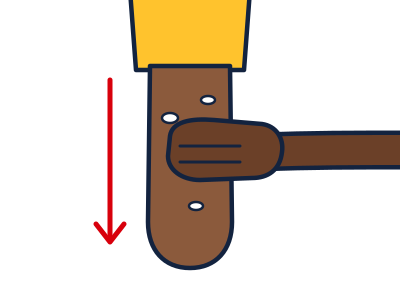
- Pat dry gently with a soft towel. Do not rub.
- Moisturise within a few minutes, while the skin is still slightly damp, to seal the water in. Apply any prescribed cream to the flared areas as your doctor has shown you.
Bath emollients and wet floors are slippery. Hold your child firmly, and never leave a baby or toddler alone in the bath, even for a moment.
Flare Triggers
Eczema comes and goes. A flare is a spell when it gets worse. Common triggers:
| Trigger | What helps |
|---|---|
| Heat and sweat | Light cotton clothing, a fan, cool baths after play. Avoid heavy wrapping and many layers on babies. |
| Harmattan dryness | Moisturise more often, keep baths short, and cover the skin when outside in dusty wind. |
| Soaps, detergents and perfumes | Soap substitutes for washing, mild unperfumed laundry products, rinse clothes well, no fabric softener. Avoid perfumed creams, powders, incense and body sprays on or near the child. |
| Rough fabrics | Cotton next to the skin. Avoid wool and scratchy synthetic uniforms; a cotton layer underneath helps. |
| Saliva and food around the mouth | Wipe gently and put a barrier moisturiser around the mouth before meals. |
| Infections and colds | Eczema often flares when a child is unwell. Keep up the routine. |
| Dust mites, pets, pollen | For some children only. Washing bedding in hot water and drying it in the sun helps. |
| Swimming pools | Moisturise before, rinse off after, then moisturise again. |
Steroid Creams, Used Correctly
When eczema flares, moisturiser alone is not enough. The usual treatment is a steroid cream or ointment prescribed by a doctor. These are not the same as the steroids athletes misuse. They calm the inflammation quickly, stop the itch, and let the skin heal.
- Steroid creams come in different strengths. A mild one is used on the face and in skin folds; a stronger one may be used for a short time on thicker skin of the body and limbs. Use only the one prescribed, only where it is prescribed.
- Use it for the time your doctor says, usually until the flare has settled and a few days beyond, and then go back to moisturiser alone. Some children are advised to use it on a couple of days each week on problem areas to stop flares returning.
- Apply the moisturiser and the steroid at different times, leaving a gap between them as your doctor advises, so one does not dilute the other.
- Other non-steroid creams may be prescribed for the face or for long-term use.
How Much: The Fingertip Unit
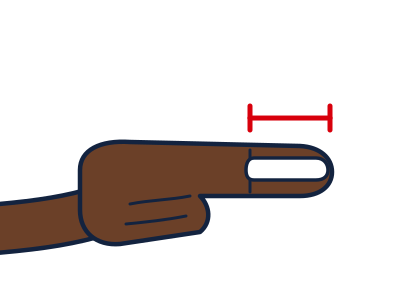
Doctors measure steroid creams in fingertip units. One fingertip unit is a line of cream squeezed from the tube along an adult's index finger, from the tip to the first crease. It covers an area of skin about the size of two flat adult hands. Your doctor will tell you how many fingertip units to use for each part of your child's body, and for how long.
The Fear of Steroids
Many parents worry that steroid creams will thin or darken the skin. When the right strength is used on the right place for the right time, as prescribed, this is very unlikely. Using too little, stopping too early, or avoiding the cream altogether leaves the skin inflamed, itchy, infected and more likely to be left with dark or pale marks. If you are worried, say so — the doctor explains the plan and shows you how much to use.
Never Use Bleaching, "Toning" or Mixed Creams
Why These Creams Harm Children
Creams sold in markets and shops to lighten or "tone" skin, and unlabelled creams mixed by sellers, often contain very strong steroids, hydroquinone or mercury. On a child's thin skin these can cause permanent stretch marks, thin fragile skin, infections, acne, uneven dark and light patches, and — because they are absorbed into the body — harm to growth, the hormone system and the kidneys. Mercury is toxic to the brain and kidneys. Never use these on children, and do not add anything to a prescribed cream.
Buy creams from a registered pharmacy, check the label and NAFDAC number, and bring every cream you use to the appointment.
Sleep and Scratching
- Keep nails short and smooth. Cotton mittens or socks on the hands can help babies at night.
- Keep the bedroom cool, with light cotton bedding, and do not overdress for sleep.
- Moisturise before bed, and keep a small pot by the bed for night-time itch.
- Distract rather than scold. Older children can learn to press or pinch the skin instead of scratching.
- Antihistamine medicines do not treat eczema itself. A doctor may occasionally suggest one for a short time during a bad flare. Do not give sleepy antihistamines to babies without medical advice.
Severe eczema that needs treatments such as wet wraps, light therapy or tablets is managed by a skin specialist. Our paediatric dermatology service at Limi treats children whose eczema is hard to control.
Eczema and Food Allergy
Babies whose eczema started early and is severe are more likely to have a food allergy, especially to egg, milk or groundnut. But food is not the cause of most eczema, and cutting foods out without testing can harm a child's growth. If eczema does not improve with a good skin routine, or a food seems to make it worse, or your child reacts quickly to a food (hives, swelling, vomiting), talk to the doctor before removing it. Introducing common allergy foods early and regularly may lower the chance of food allergy — see our guide to allergies and starting solids.
School and Play
- Send a small, labelled pot of moisturiser for use after washing hands, sport and swimming.
- Ask for a cotton uniform or a cotton layer under a synthetic one.
- Let the teacher know that eczema is not infectious, so other children do not avoid your child.
- Sport and swimming are fine. Rinse off sweat and chlorine and moisturise afterwards.
Myths About Eczema
Eczema is contagious.
It is not. Other children cannot catch it.
Eczema is caused by dirt, so wash the child more with strong soap.
Soap strips the skin's natural oils and makes eczema worse. Short baths with a soap substitute are better.
Steroid creams bleach the skin, so avoid them.
Prescribed steroid creams used as directed do not bleach normal skin. The light and dark patches are usually left by the eczema itself. Bleaching creams are different and dangerous.
The baby is reacting to the mother's breast milk; stop breastfeeding.
Breastfeeding is good for babies with eczema. Do not stop or change your diet without advice from a doctor.
Shea butter, palm kernel oil or herbal mixtures will cure it.
Nothing cures eczema. Plain, unperfumed moisturisers help; some oils and herbal products irritate the skin or cause allergy. Test any new product on a small patch first.
Questions Parents Ask
Will my child grow out of eczema?
Many children improve a great deal by school age or the teenage years. Some keep dry, sensitive skin, and some develop asthma or hay fever. Good control now makes life more comfortable whatever happens later.
Which moisturiser should I buy?
There is no single right one. Choose plain, unperfumed products your child tolerates and that you can afford to use in large amounts. Greasy ointments protect more; creams and lotions are lighter. You can use a thicker one at night and a lighter one in the day.
Does infected eczema need antibiotics?
Sometimes. A doctor needs to see the skin to decide, and may take a swab. Eczema herpeticum needs an antiviral medicine urgently. Do not use leftover antibiotic creams or tablets.
Can my child with eczema have vaccines?
Yes. Eczema is not a reason to delay any vaccine. Give them on the usual schedule; see our vaccine schedule.
A relative has a cold sore. Is that a risk?
Yes. The cold sore virus can cause eczema herpeticum. Anyone with a cold sore should not kiss your child and should wash their hands before touching them until the sore has healed.
Will the dark and light patches go away?
Usually, yes, but slowly — often over several months once the eczema is controlled. Protect the skin from strong sun, and do not use lightening creams to even them out.
Sources
- National Institute for Health and Care Excellence. Atopic eczema in under 12s: diagnosis and management (CG57). 2007, updated 2023.
- National Institute for Health and Care Excellence. Clinical Knowledge Summaries: Eczema — atopic. Updated regularly.
- American Academy of Pediatrics. Eczema in babies and children. HealthyChildren.org.
- Long CC, Finlay AY. The finger-tip unit: a new practical measure. Clinical and Experimental Dermatology, 1991.
- Danby SG and others. Effect of olive and sunflower seed oil on the adult skin barrier: implications for neonatal skin care. Pediatric Dermatology, 2013.
- World Health Organization. Mercury in skin lightening products. Information sheet, 2019.
Written for parents and carers in NigeriaClinically reviewed by Limi Children’s Hospital cliniciansLast updated September 2026Next review due September 2027