Most serious injuries to young children happen at home, and most of them follow the same few
patterns: burns in the kitchen, poisoning from things stored in drink bottles, drowning in a bucket or well,
falls from windows and balconies, and cars in the compound. Walk through your home with this list. Each change
takes minutes and lasts for years.
Get down to your child's eye level in each room — on your knees for a crawling baby, standing but stooped for a
toddler. Look for what they can reach, open, pull, climb or put in their mouth. Children learn to crawl, stand,
climb and open things faster than parents expect, so go through the list again at each new stage.
Supervision comes first, but nobody can watch every second. Set up the home so a moment's
distraction does not end in hospital.
Everyone in the house needs to know the rules: grandparents, nannies, older children, the
driver and the gateman.
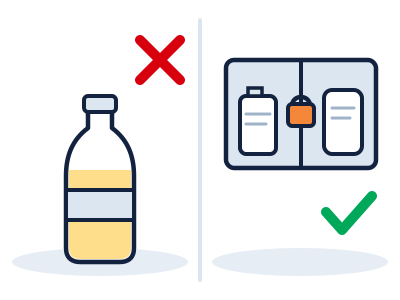
Never in a drink bottle. Own container, labelled, locked and high.
Ticks are saved on this phone only.
Medicines
0 done
Ticks are saved on this phone only.
Water
0 done
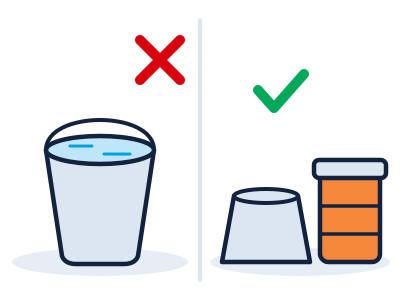
Empty it and turn it over, or cover it tightly.
Drowning is silent and fast. A toddler who leans into a bucket can tip in head first and cannot climb out. A few
centimetres of water is enough.
Ticks are saved on this phone only.
Windows, Balconies and Stairs
0 done
Ticks are saved on this phone only.
Electricity and Generators
0 done
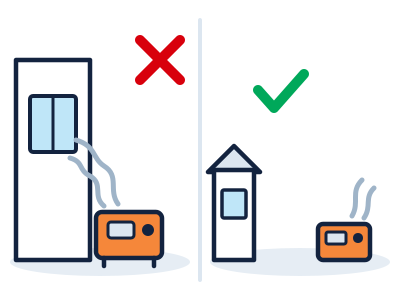
Generators outside, well away from windows and doors.
Generators and Carbon Monoxide
Sockets and Wiring
Ticks are saved on this phone only.
Fire, Coils and Candles
0 done
Ticks are saved on this phone only.
Living and Sleeping Rooms
0 done
Things That Tip Over
Things That Go In Mouths
Things That Suffocate or Strangle
Ticks are saved on this phone only.
The Compound, Gate and Car
0 done
The Compound and Gate
In the Car
Ticks are saved on this phone only.
Questions Parents Ask
This is a long list. Where should I start?
Start with the things that kill or cause lifelong harm: fuel and chemicals in drink bottles, buckets and
wells, the generator's position, windows and balconies, and car seats. Then work through the rest a room a week.
Can I just teach my child not to touch things?
Teaching helps as children grow, and you should start early. But children under five cannot reliably
remember rules, judge danger or stop themselves when they are curious. Changing the home protects them while
they learn.
How do I make sure the nanny and relatives follow these rules?
Walk round the house together with this list, explain why each rule matters, and print it for the fridge.
People follow rules they understand. Share the first aid guide with them too.
Car seats are expensive. Is a seat belt enough for a young child?
Adult seat belts do not fit small children: in a crash the belt can cut across the neck and tummy. A
correctly fitted car seat is the most effective protection for a child in a car. A good second-hand seat can be
safe if you know it has never been in a crash, has all its parts and instructions, and is within the date on its
label.
Where can I get a carbon monoxide alarm?
They are sold in electrical and hardware shops and online. Choose a battery or plug-in alarm that states
it detects carbon monoxide (a smoke alarm does not), and test it every month.
Sources
World Health Organization and UNICEF. World report on child injury prevention. 2008.
World Health Organization. Global report on drowning: preventing a leading killer. 2014.
Durbin DR, Hoffman BD; Council on Injury, Violence, and Poison Prevention. Child passenger safety. Pediatrics. 2018;142(5):e20182460.
American Academy of Pediatrics, Committee on Injury, Violence, and Poison Prevention. Prevention of choking among children. Pediatrics. 2010;125(3):601–607.
Centers for Disease Control and Prevention. Preventing carbon monoxide poisoning.
World Health Organization. Pocket book of hospital care for children (poisoning, burns). 2nd edition, 2013.
Written for parents and carers in NigeriaClinically reviewed by Limi Children’s Hospital cliniciansLast updated September 2026Next review due September 2027
If your child is seriously unwell, do not book and do not wait for a message reply.
Come to Limi Children's Hospital now, day or night, or go to the nearest emergency department if you
cannot get here quickly. Have someone else drive if you can, so you can watch your child, and call
0813 408 5400 on the way so the team can prepare. See the signs that mean go now.
Seriously unwell? Come to Limi Children's Hospital now, day or night. If you cannot get there quickly, go to the nearest emergency department. Call 0813 408 5400 on the way.
Printed from the Limi Children's Hospital parent library at limichildrenshospital.ng. This information helps you
understand and prepare; it cannot examine your child. A member of The Limi Hospitals, caring for families since 1982.