
If You Remember Nothing Else
- Understanding comes before talking. A child who understands well but says little is still worth a check if they are behind the ages below.
- No words by 18 months, or no two-word phrases by 2 years, means ask for a check — not "wait and see".
- Losing words or skills at any age needs to be seen soon. This is never something to wait on.
- Two or three languages do not cause delay. Count your child's words across all of them, and speak the language you know best.
- Every child with a speech worry needs a hearing test first. A child cannot copy sounds they cannot hear clearly.
- Talk, read, sing and wait. Everyday chat with you teaches far more than any screen or video.
What Talking Looks Like by Age
There are two sides to language. Understanding (receptive language) is what your child takes in: following what you say, knowing the names of things, answering questions. Speaking (expressive language) is what comes out: sounds, words, then sentences. Speech also includes how clearly the sounds are made. Most children understand far more than they can say.
The table shows what most children can do by each age. It is a guide, not an exam. If your child is a little behind in one row but moving forward, that is often fine. If they are behind in several rows, or not moving forward, ask for a check. Our milestone checker takes you through talking, movement, play and social skills together, age by age.
| By this age | Most children understand | Most children say or do |
|---|---|---|
| 12 months | Turn to their name. Know a few everyday words like "mama", "bye-bye" or "no". Look where you point. | Babble strings of sounds like "bababa" and "mamama". Wave bye-bye. May say one or two words with meaning, such as "mama" or "dada". |
| 18 months | Follow a simple instruction without you pointing, such as "give me the cup". Look at or point to a familiar person or object when you name it. | Say at least three words besides "mama" and "dada", often many more. Point to show you something interesting. |
| 24 months | Point to pictures in a book when you name them, and to at least two body parts. Understand simple questions like "where is your shoe?". | Put two words together, such as "more milk" or "daddy gone". Many use 50 words or more across their languages. |
| 36 months | Follow two-step instructions, such as "pick up the ball and give it to me". Understand "in", "on" and "under". | Talk in short sentences of three or four words. Ask "what", "where" and "why". Say their first name. Familiar adults understand most of what they say. |
| 4 years | Follow a simple story. Answer questions like "what do we use a cup for?". | Use sentences of four words or more. Tell you about something that happened. People outside the family understand most of what they say. |
Some sounds come late, and that is normal. Many four-year-olds still say "th" as "f" or "d", or struggle with "r" and "l". A child who is hard for strangers to understand at four, or who leaves the ends off most words at three, should be checked.
Two or Three Languages at Home
Many Nigerian children hear English, Pidgin and one or more of Hausa, Yoruba, Igbo or another language every day — from parents, grandparents, a nanny and the neighbours. Families are often told that this confuses children and causes late talking. It does not. Research across many countries shows children learning two or three languages reach their milestones in the same age range as children learning one.
- Count words across all languages. If your child says "omi" for water, "mama" and "ball", that is three words. A bilingual child may know fewer words in each language, but a similar total.
- Mixing languages is normal. Using a Hausa word in an English sentence shows your child is using every word they know. It is not confusion.
- Speak the language you know best. Children learn most from rich, fluent, warm talk. A parent speaking their own language well gives more than a parent speaking English with effort. English will come, especially once school starts.
- Do not drop the home language because a child is slow to talk. Taking away a language does not speed things up, and it can cut a child off from grandparents and heritage.
A real delay shows up in every language the child hears. If your child is behind in all of them, that needs a check, and being bilingual is not the reason.
Signs That Mean Ask for a Check
You do not need to wait for a clinic visit to ask. These signs mean book a developmental or speech and language check. Losing skills is more urgent, and a sudden change with other symptoms is an emergency.
Come In Now
Emergency department, straight away
- Talking stops or becomes slurred suddenly, with weakness, a drooping face, a fit, or unusual sleepiness
- Suddenly cannot understand or speak after a head injury or a high fever
Book a Check
Losing skills: within days. The rest: do not wait for the next routine visit
- Losing words, babble or other skills your child used to have, at any age
- No babbling by 12 months
- Does not turn to their name, point, or wave by 12 to 15 months
- No single words by 16 to 18 months
- No two-word phrases by 24 months
- You cannot understand most of their talk by 3 years
- Stammering that lasts more than six months, or upsets your child
Usually Fine
Keep talking and reading; mention it at the next check
- Mixing words from two or three languages
- Saying "wabbit" for rabbit or "fank you" at three or four
- Repeating a word or sound now and then when excited, at two to five
- A burst of new words after a quiet spell
- Understanding well and just starting to join words at around two
If your child is also not playing pretend games, not interested in other children, or has very strong routines, read our guide to autism as well — speech delay is one of the most common reasons families first ask about it, and an assessment looks at the whole child.
Check Hearing First
Hearing is the first thing to test in any child with a speech or language worry. Even a mild hearing loss makes speech sound muffled, like listening through a wall. Many babies in Nigeria are not screened at birth, so a hearing loss can go unnoticed for years.
The most common cause in young children is glue ear — sticky fluid behind the eardrum after colds and ear infections. It comes and goes, so a child may seem to hear well one week and ignore you the next. Other signs are turning the TV up, saying "eh?" often, or speaking very loudly. Hearing can be tested at any age, even in babies; the test does not hurt. Read our guide to ears and hearing for more.
Screens and Background TV
Children learn to talk from people, not screens. A cartoon cannot wait for your child's answer, notice what they are looking at, or smile when they try a new word. The World Health Organization advises no screen time for children under 2 (video calls with family are fine), and no more than one hour a day for children aged 2 to 4 — less is better.
Background TV matters too. When a television is on in the room, adults talk less to children, and children play for shorter spells, even if nobody is watching. In many homes the TV runs all day. Switch it off when nobody is watching, and at mealtimes. If your child does watch, sit with them and talk about what you see: "Look, the goat is eating. What is the goat eating?"
Everyday Ways to Build Language
You do not need special toys, flashcards or lessons. Most language learning happens during the things you already do — cooking, bathing, dressing, shopping at the market, sitting in traffic. Grandparents, older brothers and sisters and nannies can all do this too.
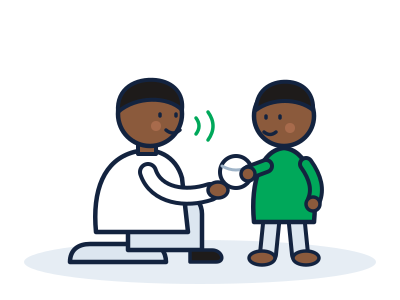
- Talk while you do things. Say what you are doing in short, simple words: "Mummy is cutting the yam. Cut, cut. Now it goes in the pot. Hot!"
- Name what your child is looking at. Follow their eyes and their pointing finger. If they look at a lorry, say "Big lorry. Red lorry." Words stick best when they match what the child is interested in right now.
- Follow their lead. Join the game they have chosen instead of steering them to yours. Play is where most language is learnt.
- Pause and wait. After you speak, count slowly to five in your head. Give your child a chance to answer with a sound, a word or a gesture. Many parents fill every silence without meaning to.
- Add one word. If your child says "ball", you say "big ball" or "throw ball". If they say "car go", you say "the car is going fast". This is called expanding, and it shows the next step without correcting.
- Say it back the right way, without making them repeat it. If your child says "me goed market", say "Yes, you went to the market" — then carry on. Asking a child to say it again "properly" can make them go quiet.
- Read and sing every day. Share a picture book for a few minutes, point to things and name them. Sing the same songs and rhymes again and again, in any language, and leave a gap for your child to fill in the last word.
- Give choices. "Banana or orange?" gives your child the words they need to answer.
With a toddler, reading can simply mean talking about the pictures. Books in Nigerian languages, and home-made books of family photos, work just as well.
Stammering
Between about 2 and 5 years, many children go through a stage of repeating words or phrases — "I-I-I want" or "can I, can I have" — especially when excited, tired, or when their ideas are running ahead of their words. This normal disfluency usually comes and goes and fades by itself.
A stammer (also called a stutter) is different. Signs include repeating parts of words ("b-b-b-ball"), stretching sounds ("sssssock"), getting stuck with no sound coming out, tension in the face, blinking or head movements while trying to talk, or avoiding speaking. Most young children who start to stammer stop within a few years, but it is not possible to tell in advance who will. Ask for an assessment if the stammer has lasted more than six months, is getting worse, comes with visible struggle, upsets your child, started after about age three and a half, or if someone else in the family stammers.
At home: slow your own speech down a little, give your child time to finish, and listen to what they say rather than how. Do not finish their words, tell them to "slow down" or "take a breath", or make them start again. Stammering is not caused by bad parenting, a bad habit, or a spiritual problem, and punishing it makes it worse.
Tongue-Tie
Tongue-tie means the band of skin under the tongue (the frenulum) is short or tight. Many families are told that a child who talks late is "tied" and needs the band cut. In fact, tongue-tie very rarely causes late talking. Late talking is about language — learning words and putting them together — and the tongue has nothing to do with that.
A tight frenulum can sometimes affect breastfeeding in young babies, and a small procedure may then help with feeding. For speech, cutting it rarely makes a difference, and cutting by someone without training can cause heavy bleeding, infection and scarring. If you are worried about your child's tongue, ask for an assessment by a speech and language therapist and a doctor before anyone cuts.
What a Speech and Language Therapist Does
A speech and language therapist is trained in how children learn to understand, talk, and also swallow. At Limi, speech therapists work in the development service, alongside the developmental clinics and physiotherapy, so a child who needs more than one kind of help gets it under one roof.
What Happens at an Assessment
- A conversation with you. The therapist asks about pregnancy and birth, early milestones, ear infections, which languages your child hears and from whom, and what worries you. Bring the child health card and any reports.
- Play. Most of the assessment looks like play with toys and books. The therapist watches how your child understands, communicates, uses gestures, plays and takes turns.
- Hearing. If your child has not had a recent hearing test, the therapist arranges one.
- A plan, explained. The therapist tells you what they found, in plain words, and what happens next. Sometimes that is advice and a review; sometimes regular therapy; sometimes a referral for a wider developmental assessment.
Therapy for young children is mostly about coaching parents and carers, because a child spends far more hours with family than in a clinic. You go home with a few specific things to practise. Progress depends on what happens between sessions, so bring the nanny and grandparents to a session too.
Early Questions Deserve Expert Answers — Not Labels or Blame
Asking about your child's talking does not mean something is wrong, and it does not mean you have done anything wrong. An assessment is how you find out whether your child simply needs time, a little extra help, or something more. Book a development appointment or read about the development service.
What People Say, and What Is True
Boys talk late. Leave him, he will talk when he is ready.
Boys are on average a little later than girls, but only by weeks. A boy with no words at 18 months or no phrases at 2 years needs a check, just like a girl.
Speaking two languages is confusing him. Stick to English.
Being bilingual does not cause delay. Speak the language you know best and count words in all of them.
His tongue is tied. Cut it and he will talk.
Tongue-tie rarely affects talking. Cutting it will not bring words, and unsafe cutting causes bleeding and infection.
Late talking is a spiritual problem, or a sign the child is stubborn.
Speech and language delay has medical and developmental causes, such as hearing loss or differences in how the brain develops. Prayer and support from family can sit alongside proper assessment, not replace it.
Educational videos will teach her to talk.
Young children learn language from back-and-forth talk with people. Under 2, screens teach very little and replace time with you.
Questions Parents Ask
My child understands everything but does not talk. Should I worry?
Good understanding is a very reassuring sign, and many of these children catch up. But if your child has no words by 18 months or no phrases by 2 years, ask for a check anyway. Some children need a little help to get words out, and a therapist shows you how to encourage them.
Grandma speaks Yoruba, we speak English, the nanny speaks Pidgin. Is that too much?
No. Children can learn three languages at once. What helps is plenty of warm, chatty time in each language, from people who speak it well. You do not need strict rules about who speaks what.
Will starting school early help my child talk?
A good nursery with small groups and chatty adults can help. But a busy class does not replace one-to-one talk at home, and it does not replace an assessment if your child is behind.
Does late talking mean my child is autistic?
Usually not. Most late talkers are not autistic. But speech delay is one of the early signs of autism in some children, especially with little pointing, not responding to their name, or not showing you things. An assessment looks at all of this together. See our guide to autism.
How long does speech therapy take?
It depends on the child and the cause. Some children need a few sessions and a home plan; others need support over months or years. The therapist sets goals with you and explains how progress is measured. Ask the care team about the number and cost of sessions.
My child is 6 and still hard to understand. Is it too late?
No. Therapy helps at any age, and school-age children can make good progress. Unclear speech at six can affect reading, confidence and friendships, so book an assessment now.
Sources
- Zubler JM, et al (American Academy of Pediatrics and CDC). Evidence-informed milestones for developmental surveillance tools. Pediatrics, 2022.
- World Health Organization. Guidelines on physical activity, sedentary behaviour and sleep for children under 5 years of age. 2019.
- American Academy of Pediatrics, Council on Communications and Media. Media and young minds. Pediatrics, 2016.
- World Health Organization, UNICEF and World Bank Group. Nurturing care for early childhood development. 2018.
- Byers-Heinlein K, Lew-Williams C. Bilingualism in the early years: what the science says. LEARNing Landscapes, 2013.
- National Institute for Health and Care Excellence. Autism spectrum disorder in under 19s: recognition, referral and diagnosis (CG128). 2011, updated 2017.
- National Institute for Health and Care Excellence. Division of ankyloglossia (tongue-tie) for breastfeeding (IPG149). 2005.
Written for parents and carers in NigeriaClinically reviewed by Limi Children’s Hospital cliniciansLast updated September 2026Next review due September 2027