
If You Remember Nothing Else
- Back to sleep, for every sleep, day and night, from birth.
- Baby's own flat, firm space in your room for at least the first six months.
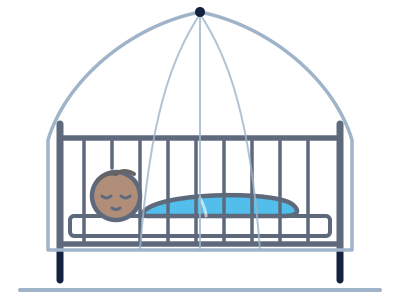
- Nothing in the cot but the baby: no pillows, duvets, thick wrappers, bumpers or soft toys.
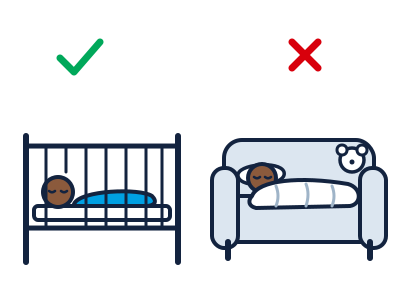
- Never fall asleep with a baby on a sofa or armchair.
- Do not share a bed if anyone in it has smoked, drunk alcohol, taken drugs or sleep-making medicine, or is exhausted, or if the baby was born early or small.
- Dress for the heat, not over it. No hats in bed, and keep the head uncovered.
- Never run a generator indoors or near windows and doors. Its fumes can kill a whole household in their sleep.
Safe Sleep at a Glance
Sudden infant death syndrome (SIDS), sometimes called cot death, is the sudden and unexplained death of a baby, usually during sleep. Most happen in the first six months, and most often between one and four months. Other sleep deaths happen when a baby's breathing is blocked by bedding, a pillow, or an adult's body. The advice below lowers the risk of both.
Always on the Back
Put your baby down to sleep on their back every time, for naps as well as at night, from the day they are born. Babies who usually sleep on their back but are put on their tummy or side once are at particular risk, so tell grandparents, nannies and anyone else who puts your baby down.
Parents often worry that a baby on their back will choke if they bring up milk. Healthy babies have a strong reflex that protects the airway, and choking is not more common on the back. Side sleeping is not safe either, because babies easily roll from the side onto the tummy.
Once your baby can roll from back to tummy and back again on their own, usually around five to six months, you can leave them in the position they choose. Keep putting them down on their back.
If your baby falls asleep in a car seat, bouncer, swing or a wrapper on your back, move them to a flat surface when you can. Sitting devices let the head fall forward, which can narrow the airway. When carrying a baby in a sling or wrapper, keep their face visible, their nose and mouth clear, and their chin off their chest.
Tummy time is for when your baby is awake and someone is watching. It strengthens the neck and helps prevent a flat patch on the back of the head.
A Flat, Clear Space in Your Room
The safest place for a baby to sleep is their own cot, crib or basket, in the same room as a parent, for at least the first six months. Being close lets you hear and respond to your baby, and it lowers the risk of SIDS.
- Firm and flat: a firm mattress that fits the cot without gaps at the sides. Soft mattresses, foam pads, and old or sagging mattresses can let a baby's face sink in.
- Nothing else in the cot: no pillows, duvets, quilts, thick wrappers, cot bumpers, soft toys, sleep positioners or rolled towels.
- Feet to foot: place your baby with their feet at the foot of the cot, so they cannot wriggle down under anything.
- No cot? A firm, flat mat on the floor beside your bed, or a sturdy basket or box with a firm base, is safer than an adult bed or sofa.
- Away from hazards: keep cords from blinds, curtains and phone chargers out of reach.
Sofas and Armchairs
Falling asleep with a baby on a sofa or armchair is one of the most dangerous situations of all. Babies can slip into the gap between an adult and the cushions and be unable to breathe. If you are feeding at night and feel you might fall asleep, feed in bed, with pillows and covers moved away from the baby, rather than on a sofa. Put the baby back in their own space when the feed is done.
Sharing a Bed with Your Baby
In many Nigerian homes, babies sleep with their mother, and in small rooms there may be no space for a cot. The safest choice is still a separate flat space next to your bed. If you do share, these rules lower the risk.
Never Share a Bed with Your Baby If
- you or anyone else in the bed smokes, even if never in the bedroom
- you or anyone in the bed has drunk alcohol, used drugs, or taken medicine that makes you drowsy
- you are extremely tired, for example after a very difficult night
- your baby was born before 37 weeks, or weighed less than 2.5 kg at birth
- the mattress is soft, sagging or a waterbed, or you are on a sofa or armchair
The risk is also highest in the first four months. If you do share a bed:
- Put your baby on their back, on a firm mattress, away from pillows and duvets.
- Keep your baby on the mother's side, not between two adults, and never next to other children or pets.
- Make sure the baby cannot fall out or get stuck between the mattress and the wall.
- Do not wrap or swaddle a baby who is sharing a bed; they need their arms free and must not overheat.
- Breastfeeding mothers naturally curl around the baby, facing them, with an arm above the head. This position protects the baby.
Heat and Wrapping
Overheating raises the risk of SIDS. In Abuja's heat, most babies need very little on at night.
- Dress your baby in no more than one light layer more than you would wear to be comfortable in the room. On a hot night that may be a nappy and a vest.
- Usually no covering is needed. On a cool harmattan night or in air conditioning, add a sleepsuit or use a baby sleeping bag that fits well at the neck. If you use a thin sheet, tuck it firmly under the mattress, no higher than the baby's chest, with the feet at the foot of the cot.
- Keep the head uncovered — no hats or caps in bed. Babies lose heat through the head.
- Check the chest or back of the neck. Sweating, damp hair or heat rash means remove a layer.
- A fan or air conditioner is fine, as long as it does not blow straight at the baby and the cot is away from the unit.
Using Nets Safely
Malaria is dangerous for babies, so a long-lasting insecticide-treated net over every sleep space is part of safe sleep in Nigeria. Treated nets are safe to use over babies.
- Hang the net from above and tuck it firmly under the mattress all the way round, so it is taut and not loose.
- The net goes over the cot, never lying on the baby or bunched up inside the cot where it could wrap around them.
- If your baby sleeps on a mat, hang the net over the mat and tuck it under the edges.
- Check for holes and mend them, and use the net for daytime naps too.
- Do not burn mosquito coils or spray insecticide in the room where the baby sleeps.
Smoke, Generators and Carbon Monoxide
Babies breathe faster than adults, so smoke and fumes affect them more.
Tobacco smoke is one of the strongest risks for SIDS. Keep your home and car smoke-free. If a parent smokes, the risk is higher even if they only smoke outside, which is why bed-sharing is never safe with a smoker.
Generators, charcoal stoves (coal pots) and kerosene heaters give off carbon monoxide, a gas you cannot see or smell. In a closed space it builds up while people sleep, and it can kill everyone in a room or house. Families in Nigeria are lost this way every year.
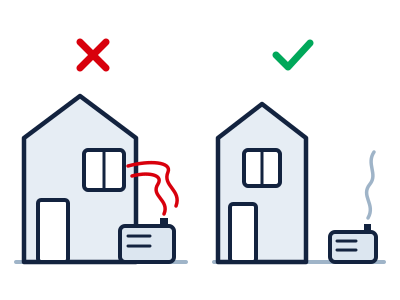
- Never run a generator indoors, in a garage, on an enclosed veranda, in a corridor or shop front, or near a window, door or air vent — even with them open.
- Place it outside and well away from the house, exhaust pointing away from any building.
- If it cannot be placed safely, switch it off before everyone sleeps.
- Never bring a charcoal stove indoors for heat or cooking, and never sleep in a room with one burning.
- A battery carbon monoxide alarm near the bedrooms gives an early warning.
Headache, dizziness, sickness, drowsiness or confusion in several people at once — or a baby who is unusually sleepy, floppy or vomiting — can be carbon monoxide poisoning. Get everyone into fresh air, switch off the source if it is safe to do so, and come to Limi now: babies and children to Limi Children's Hospital, adults to The Limi Hospital. If you cannot get there quickly, go to the nearest emergency department. If a baby or child is not breathing, start rescue breathing and chest compressions — see CPR — and shout for help.
How Much Sleep Children Need
These are the usual ranges in 24 hours, including naps, from international sleep experts. A child who is growing, happy and alert during the day is usually getting enough.
| Age | Total sleep in 24 hours | Naps and night sleep |
|---|---|---|
| Newborn to 3 months | About 14 to 17 hours | Short sleeps round the clock, waking every 2 to 3 hours to feed. No day–night pattern yet. |
| 4 to 12 months | About 12 to 16 hours | Longer night sleep develops; usually 3 naps at 4 to 6 months, dropping to 2 by about 9 months. Many still wake at night. |
| 1 to 2 years | About 11 to 14 hours | Most move from 2 naps to 1 afternoon nap between 12 and 18 months. |
| 3 years | About 10 to 13 hours | Often one afternoon nap, which some children drop around this age. |
Routines and Night Waking
Newborns do not know day from night. Teach them from the start: keep daytime bright and sociable, and night feeds dim, quiet and brief, with no play. From about three months, a short bedtime routine done in the same order each night helps your baby learn that sleep is coming:
- Wash or bath, then a clean nappy and night clothes.
- A feed, in a dim room.
- A quiet song, prayer or story. Keep it the same each night.
- Into the cot on their back, drowsy but awake, so they learn to settle there.
For toddlers, keep screens off for at least an hour before bed, and keep the bedtime and wake-up time roughly the same every day.
Night waking is normal. Young babies wake because they need milk. Many babies still wake once or more at night at six months and beyond, especially when teething, unwell, or learning to crawl or stand. Around eight to ten months, many babies become upset when a parent leaves the room; a calm, brief response helps. Toddlers may wake with bad dreams — comfort them and settle them back in their own bed.
When to Talk to a Doctor About Sleep
Come In Now
Emergency department, straight away
- Pauses in breathing of 20 seconds or more, or with blue or grey colour
- Very hard to wake, or floppy when woken
- Fast, noisy or laboured breathing during sleep
- A fit during sleep
- A baby who is much sleepier than usual and not feeding well
- Signs of carbon monoxide poisoning
See a Doctor Soon
Book an appointment this week
- Loud snoring most nights, with gasps, snorts or pauses
- Breathing through the mouth all the time, restless sleep, and tired or irritable in the day
- Sleep problems that leave you exhausted or low
Usually Normal
Mention it at the next check
- Grunts, squeaks and twitches in sleep
- Irregular breathing with short pauses that settle
- Waking at night for feeds or comfort
- Occasional snoring with a cold
Snoring with pauses is often caused by large tonsils or adenoids, and can affect growth, behaviour and learning. It can be treated: the ENT team at Limi assesses your child and treats the cause. If any of the "come in now" signs appear, come to Limi Children's Hospital now, day or night, and call 0813 408 5400 on the way so the team can prepare. If you cannot get here quickly, go to the nearest emergency department.
Questions Parents Ask
My baby rolls onto their tummy in their sleep. Should I turn them back?
If your baby can roll both ways on their own, you do not need to keep turning them. Always put them down on their back, and keep the cot clear so there is nothing to press their face into. If they roll before they can roll back, gently turn them onto their back.
Should I use a special pillow to stop a flat head?
No. Pillows and head-shaping cushions are not safe for sleep. Give plenty of tummy time while awake, hold your baby upright, and alternate which end of the cot the head goes. Most flat patches improve as babies sit and move more.
Can my baby sleep on my back in a wrapper?
Carrying a baby on your back is a close, comforting tradition, and short naps there are common. Make sure you can see the baby's face, that the nose and mouth are clear and the chin is not pressed to the chest, and check often. For longer sleeps, lay the baby on their back on a flat surface.
Is swaddling safe?
A light, thin wrap can settle a young baby, as long as it is not too tight around the chest, the hips and legs are free to bend, the head is uncovered, and the baby is always on their back. Stop swaddling when your baby starts trying to roll, and never swaddle when bed-sharing.
When can my child have a pillow or a soft toy in bed?
Keep the cot clear for the first year. After 12 months a small soft toy is fine. Most children do not need a pillow until they move to a bed, often around two years or later.
Can twins sleep in the same cot?
The safest advice is for each baby to have their own flat, clear sleep space. If twins share a cot for a short time, place each on their back at opposite ends, feet to foot, with nothing else in the cot, and separate them once they start to roll.
Sources
- Moon RY, Carlin RF, Hand I, American Academy of Pediatrics. Sleep-related infant deaths: updated 2022 recommendations for reducing infant deaths in the sleep environment. Pediatrics, 2022.
- National Institute for Health and Care Excellence. Postnatal care (NG194). 2021.
- Paruthi S and others. Recommended amount of sleep for pediatric populations: a consensus statement of the American Academy of Sleep Medicine. Journal of Clinical Sleep Medicine, 2016.
- Hirshkowitz M and others. National Sleep Foundation's sleep time duration recommendations. Sleep Health, 2015.
- World Health Organization. WHO guidelines for malaria. 2023.
- World Health Organization. WHO guidelines for indoor air quality: selected pollutants (carbon monoxide). 2010.
Written for parents and carers in NigeriaClinically reviewed by Limi Children’s Hospital cliniciansLast updated September 2026Next review due September 2027