

If You Remember Nothing Else
- Sudden pain in a testicle is an emergency. Go straight to hospital, day or night — the testicle can often be saved only in the first few hours.
- A hard, painful lump in the groin or belly button that will not go back is an emergency, especially with vomiting.
- A soft bulge at the belly button is common and usually closes by itself by age 4 or 5. Do not tie coins, belts or tape over it.
- A groin lump that comes and goes is a hernia until proven otherwise. It will not close by itself and needs a surgeon soon.
- A testicle that is not in the scrotum by 3 months needs a surgeon. The operation is best done between 6 and 12 months, and by 18 months at the latest.
- Green vomit, or bouts of screaming with blood or jelly in the poo, means come in now.
When to Come In
Come In Now
Emergency department, straight away
- Sudden pain in a testicle, the scrotum, the groin or lower tummy in a boy
- A lump in the groin, scrotum or belly button that is hard, painful or discoloured, or will not go back
- Vomiting green or yellow-green fluid, at any age
- Bouts of screaming with legs drawn up, or poo with blood or red jelly
- Forceful vomiting after every feed in a baby with fewer wet nappies or who is sleepy
- A foreskin stuck behind the head of the penis with swelling
- After circumcision: bleeding that does not stop with 10 minutes of firm pressure, or no wee for 8 hours
See a Doctor Soon
Within days — ask for a children's surgeon; sooner for young babies
- A soft lump in the groin, scrotum or labia that comes and goes
- A testicle that cannot be felt in the scrotum at 3 months
- A scrotal swelling that changes size during the day
- Pain or crying when weeing, or a red, swollen foreskin
- Vomiting with force after feeds in a baby aged 2 to 8 weeks who is otherwise well — see a doctor the same day
Usually Fine for Now
Mention it at the next check
- A soft belly-button bulge that pushes back easily and grows when crying
- A soft, painless, fluid-filled scrotum in a newborn
- A foreskin that will not pull back in a young boy
- The foreskin ballooning a little when weeing, with a good stream
Coming to Limi? Call 0813 408 5400 on the way so the team can prepare, and have someone else drive if you can.
Where to Look
Most of these conditions are found at nappy changes and bath time. Knowing where to look helps you describe what you have seen to the doctor.
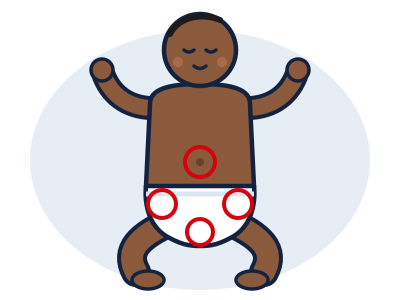
Take a photo on your phone of a lump that comes and goes, because it may have gone back in by the time you see the doctor.
Umbilical Hernia: A Bulge at the Belly Button
Before birth, blood vessels pass through a gap in the tummy muscles at the belly button. Sometimes the gap takes a while to close after birth, and a soft bulge pokes out, getting bigger when the baby cries, coughs or strains, and flattening when they are calm. It is very common in African babies and in babies born early. It does not usually hurt.
Most close by themselves by 3 to 5 years, even large ones. A surgeon advises an operation if it is still there at 4 or 5 years, if it is very large, or if it ever becomes stuck. Umbilical hernias in children rarely get stuck, but if the bulge becomes hard, painful, red or dark, or will not go back, come in now.
No Coins, Belts or Strapping
Many families are advised to tie a coin, a button or a bandage over the belly button, or wrap a belt around the tummy. This does not make the hernia close faster. It can rub the skin raw, cause infection, and hide a hernia that has become stuck. Leave the belly button uncovered and let it close by itself.
Inguinal Hernia: A Lump in the Groin
Before birth, each testicle travels down from the tummy into the scrotum through a channel in the groin, which should then close. If it stays open, a loop of bowel or fluid can slip down into it. This makes a soft lump in the groin or scrotum that comes and goes, often showing when the child cries or strains and disappearing when they are asleep. Girls have the same channel, and in them the lump is in the groin or the fold of the labia. Inguinal hernias are more common in boys and in babies born early.
An inguinal hernia does not close by itself, and it can become stuck (incarcerated). So every inguinal hernia needs an operation, which is usually planned soon after the diagnosis — sooner for young babies, who have the highest risk of the hernia getting stuck. The operation closes the channel through a small cut in the groin, and many children go home the same day.
A Stuck Hernia Is an Emergency
If the lump becomes hard, tender, red or dark, will not go back, or your child is in pain, vomiting or not feeding, the bowel may be trapped and its blood supply at risk. Go to the emergency department now. Do not push hard on the lump yourself.
Hydrocele: A Fluid-Filled Scrotum
A hydrocele is fluid around the testicle. It makes the scrotum look swollen, often on one side. It is soft, painless, and does not bother the baby. Hydroceles are very common in newborn boys and most disappear by the age of 1 to 2 years as the fluid is absorbed.
If the swelling changes size during the day — smaller in the morning, bigger in the evening — the channel in the groin is still open (a communicating hydrocele). This behaves more like a hernia and a surgeon needs to see it. An operation is usually offered if a hydrocele is still there after about 2 years, or appears in an older child. A doctor can tell a hydrocele from a hernia by examining your child, sometimes with a torch or a quick ultrasound scan.
Undescended Testis
In some boys, one or both testicles have not come down into the scrotum by birth. This is more common in babies born early. Some come down by themselves in the first few months. If a testicle is still not in the scrotum at 3 months, your baby should see a children's surgeon.
Surgery (an orchidopexy) is recommended ideally between 6 and 12 months, and by 18 months at the latest. A testicle that stays in the warmth of the tummy or groin does not develop as well, which affects fertility later. It also has a higher risk of cancer in adult life, is harder to check, and is more likely to twist. Bringing it down early gives it the best chance to develop and makes it easy to examine. Hormone injections are not recommended as a treatment.
Many boys have a retractile testis: it slips up into the groin when cold or touched, but can be brought down gently and stays for a while. This is usually normal but should be checked each year, as a few go up permanently. If neither testicle can be felt in a newborn, especially with any other difference in the genitals, the baby should be seen by a specialist in the first days.
Testicular Torsion: Sudden Pain Is an Emergency
Torsion is when a testicle twists on its cord, cutting off its blood supply. It is most common in teenage boys, but can happen at any age, including in newborns. The testicle can usually be saved if the operation happens within about 6 hours; after that, the chance falls quickly.
- Sudden, severe pain in one testicle, sometimes felt in the groin or lower tummy
- Swelling or redness of the scrotum; the testicle may sit higher than the other
- Feeling sick or vomiting
- In a baby, a swollen, dark or firm scrotum with crying
Go straight to the emergency department — do not wait until morning, do not give pain relief and see if it settles, and do not wait for a scan appointment. When torsion is likely, a surgeon operates straight away to untwist and fix the testicle, and fix the other side so it cannot twist later.
Talk to Boys Before It Happens
Teenage boys are often too embarrassed to say "my testicle hurts". They may say they have a stomach ache, or say nothing and hope it passes. Tell your sons, simply and early, that sudden pain "down there" is something to tell you about straight away, day or night, and that nobody will be embarrassed at the hospital.
The Foreskin and Circumcision
A Foreskin That Does Not Pull Back
In baby boys, the foreskin is normally stuck to the head of the penis and cannot be pulled back. It separates slowly and naturally over many years; in most boys it pulls back easily by the teenage years. This is not a disease. Do not force it back — this causes pain, bleeding and scarring. Clean only the outside. The foreskin may balloon a little when weeing; if the stream is good and there is no pain, that is normal.
See a doctor if your son has pain when weeing, a red and swollen foreskin, repeated infections, or a tight white ring at the tip. If the foreskin gets stuck behind the head of the penis and swells (paraphimosis), come in now.
Circumcision
Many Nigerian families circumcise their sons for religious, cultural or health reasons. Whether to circumcise is a family decision. What matters most is that it is done safely:
- By a trained health worker, with clean, sterile instruments, in a clinic or hospital
- With proper pain relief — babies feel pain; a local anaesthetic should always be used
- On a healthy baby — wait if your baby is unwell, very jaundiced or born early
- Not if the opening is not at the tip of the penis (hypospadias) or the penis looks unusual in any way — the foreskin may be needed to repair it later. A surgeon should see the baby first.
- Not before telling the doctor about any bleeding problems in the family
Circumcision by untrained practitioners, with shared or unclean blades, causes heavy bleeding, infection, tetanus, and sometimes lasting injury to the penis. After any circumcision, watch for bleeding that does not stop with firm pressure, no wee for 8 hours, swelling, pus or fever — see the warning signs above.
Pyloric Stenosis: Forceful Vomiting in Young Babies
The pylorus is the muscle at the outlet of the stomach. In some babies it thickens in the first weeks of life and blocks milk from leaving the stomach. It is more common in boys, often the first-born.
- Starts usually between 2 and 8 weeks of age
- Projectile vomiting — milk shooting out forcefully, sometimes across the room — after most feeds, getting worse over days
- The vomit is milky or curdled, not green
- The baby is hungry and wants to feed again straight after vomiting
- Fewer wet nappies, fewer stools, weight loss, and later sleepiness
It is different from ordinary posseting, where small amounts of milk dribble out. A baby with forceful vomiting after feeds needs to see a doctor the same day, and to come in now if they have fewer wet nappies or are sleepy. Pyloric stenosis is confirmed with an ultrasound scan. Babies first get fluids through a drip to correct dehydration and salt levels, then a short operation (pyloromyotomy) to loosen the muscle. Most babies feed normally within a day or two and have no further problems.
Green vomit is different and may mean a twisted or blocked bowel. At any age, green vomiting means come in now.
Intussusception: Bouts of Screaming
Intussusception is when one part of the bowel slides into the next, like a telescope, causing a blockage. It is most common between about 6 months and 2 years, but can happen from 3 months to older children. It is an emergency.
- Sudden bouts of severe crying or screaming, with the knees drawn up to the tummy, often every 15 to 20 minutes
- Between bouts, the child may seem well, or pale, quiet and floppy
- Vomiting, which may become green
- Poo with blood and mucus that looks like redcurrant jelly — this is often a late sign, so do not wait for it
It is diagnosed with an ultrasound scan. Many children are treated without an operation, using air or fluid passed gently into the bowel through the bottom, under X-ray or ultrasound, to push it back. If that does not work, or the child is very unwell, an operation is needed. The sooner it is treated, the more likely it can be fixed without surgery.
What People Say, and What Is True
Tie a coin on the belly button to push the hernia back.
Coins, belts and tape do not help it close and can cause skin infection. Most close by themselves.
The baby's hernia is from crying too much.
Crying makes a hernia show, but does not cause it. The gap was there from birth.
The testicle will come down by itself when he grows.
If it has not come down by 3 to 6 months, it is unlikely to. Waiting for years affects fertility.
Pain in the testicle is a strain from football. Rest and see.
Sudden testicular pain is torsion until proven otherwise. Hours matter.
Questions Parents Ask
Is my baby too young for a hernia operation?
No. Inguinal hernia operations are done safely in very young babies, including newborns in the NICU. The risk of a hernia getting stuck is highest in the first months, which is why it is not left to wait. See preparing your child for an operation.
Can a hernia come back after the operation?
It is uncommon. Occasionally a hernia appears later on the other side, because that channel was also open. Tell the surgeon if you notice a new lump.
Will an undescended testis affect my son's ability to have children?
Boys with one undescended testis that is brought down in the first 18 months usually have normal fertility. The risk is higher when both are affected or treatment is late — another reason not to wait.
How do I know if it is a hydrocele or a hernia?
You often cannot tell at home. A hydrocele is usually a steady, soft swelling of the scrotum; a hernia comes and goes and may reach up into the groin. Let a doctor examine your child, and bring a photo if the swelling comes and goes.
What age is best for circumcision?
Circumcision is simplest and heals fastest in the newborn period, once the baby is feeding well and has had a check to make sure the penis is normal. It can be done safely at any age by a trained team with proper pain relief.
Can girls have hernias?
Yes. Inguinal hernias are less common in girls but do happen, as a lump in the groin or labia. Sometimes the lump contains an ovary, so a surgeon needs to see it soon.
At Limi, paediatric surgery and paediatric urology work under one roof with the NICU, the PICU and emergency assessment day and night. Read about the children's surgery service and paediatric urology at Limi.
Sources
- Kolon TF, et al. Evaluation and treatment of cryptorchidism: AUA guideline. Journal of Urology, 2014.
- European Association of Urology and European Society for Paediatric Urology. EAU guidelines on paediatric urology. 2023.
- American Academy of Pediatrics Task Force on Circumcision. Circumcision policy statement. Pediatrics, 2012.
- World Health Organization. Manual for early infant male circumcision under local anaesthesia. 2010.
- Mellick LB, Sinex JE, Gibson RW, Mears K. A systematic review of testicle survival time after a torsion event. Pediatric Emergency Care, 2019.
- Kliegman RM, et al. Nelson textbook of pediatrics, 21st edition (pyloric stenosis, intussusception, hernias). Elsevier, 2020.
Written for parents and carers in NigeriaClinically reviewed by Limi Children’s Hospital cliniciansLast updated September 2026Next review due September 2027