
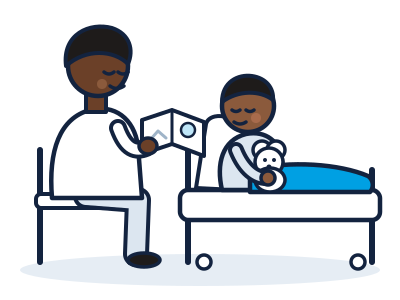
If You Remember Nothing Else
- Tell your child the truth, simply. Never say "it won't hurt" or trick them into coming. Trust matters more than a calm morning.
- Follow the fasting times the team gives you, exactly. Write them down. An empty stomach keeps your child safe under anaesthetic.
- Tell the team about coughs, colds, fever, sickle cell, bleeding problems, snoring and every medicine — including herbal mixtures.
- Ask the team whether you can stay until your child is asleep, and be there when they wake. Plan the day around the answer.
- Give pain relief as prescribed, regularly, for the first days. Do not wait for your child to complain, and do not buy codeine-containing medicines.
- Come back straight away for difficulty breathing, heavy bleeding, a child who is hard to wake, vomiting that will not stop, or severe pain.
Talking to Your Child About the Operation
Many parents want to protect their child by saying nothing until the last minute, or by saying "we are just going to see the doctor". Children usually find out anyway, and a child who feels tricked is more frightened, harder to settle, and less trusting at the next hospital visit. Studies show that children who are prepared have less anxiety before surgery, need less pain relief and recover more smoothly.
- Be honest and simple. Explain why the operation is needed, what will happen, and that you will be there.
- Talk about what they will see, hear and feel — not the details of the surgery.
- Do not promise it will not hurt. Say instead: "It might be sore afterwards. The nurses and I will give you medicine to help, and you can tell us when it hurts."
- Never use hospital as a threat. "If you are naughty the doctor will inject you" makes every future visit harder.
- Make clear it is not a punishment. Young children sometimes believe an operation is because they did something bad.
- Invite questions. "I don't know, let's ask the nurse" is a fine answer.
- Watch your own worry. Children read their parents' faces. It is fine to say you feel a bit nervous too; speak calmly and confidently about the team.
What to Say at Each Age
Babies and Toddlers (up to About 2 Years)
They cannot understand explanations, but they notice your mood and routine. Keep to normal routines as much as possible, bring a favourite blanket or toy, and stay close. Talk soothingly even if they do not understand the words. Tell them a day or so before, in very simple words: "We are going to the hospital. The doctor will make your tummy better. Mummy will be there."
Preschool Children (About 3 to 5 Years)
Tell them two or three days before — longer gives more time to worry. Use short, concrete words and focus on what happens to their body and who will be with them.
Words You Could Use
"You are going to have an operation to fix the bump on your tummy. At the hospital a doctor will give you special sleep medicine, through a mask that smells a bit funny or a tiny straw in your hand. It is a special sleep — you will not feel anything and you will not wake up until the doctors have finished. Then you will wake up, and I will be close by. Your tummy might be sore, and we will give you medicine to help."
Avoid saying "put to sleep", which some children link with animals that die. "Special sleep" or "sleep medicine" is clearer.
School-Age Children (About 6 to 12 Years)
Tell them about a week before. They can understand more about why the operation is needed and how the body will heal. Give them some choices where you can — which toy to bring, which pyjamas to wear, whether to hold your hand or look at a book when the mask goes on. Answer questions honestly. Many worry about waking up during the operation, about pain, needles, or seeing blood. Reassure them that the anaesthetist watches them the whole time and will keep them asleep until it is finished.
Teenagers
Involve them from the start, including in talks with the surgeon, and let them ask their own questions. Respect their privacy and modesty. Teenagers may worry about scars, what they will look like, missing school or sport, and losing control. Some prefer to hear the full details; others want less. Ask them. Tell them they can talk to the team alone if they wish.
Play, Books and a Practice Visit
Play is how young children make sense of new things. A toy doctor's kit, a teddy that "has an operation" with a plaster, or a drawing of the hospital can help your child rehearse, ask questions and show you what they are worried about.
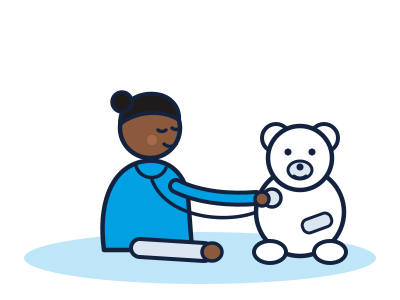
- Read a picture book about going to hospital together, or make one with drawings of the day.
- Practise the mask: let your child hold a cup or a toy mask over teddy's face, then their own, and breathe slowly.
- Teach a calming trick: blowing bubbles, slow "smell the flower, blow out the candle" breaths, or counting.
- Ask about a visit to see the ward before the day, if your child is anxious.
- Pack comfort: a favourite toy, blanket or book for waiting times.
Fasting: Why It Matters
A general anaesthetic relaxes the muscles that normally stop food coming back up from the stomach, and switches off the cough that protects the lungs. If there is food or milk in the stomach, it can come up and go into the lungs, causing a serious lung injury. Fasting before the anaesthetic makes this very unlikely.
The team gives you the exact times to stop solid food, to stop milk (breast milk and formula have different times), and to stop clear fluids. These times depend on your child's age, the operation and when it is scheduled, so follow the times you are given rather than advice from friends or the internet. Write them down.
- Do not stop drinks earlier than you are told. Children who go too long without clear fluids become thirsty, upset, dehydrated and can have low blood sugar. Current guidance encourages clear fluids until closer to the anaesthetic than in the past.
- Sweets, chewing gum, tea with milk, pap and fruit juice with bits all count as food or milk, not clear fluids. Ask the team what counts as clear if you are unsure.
- Keep food out of sight. Eat your own meal away from your child, and ask visitors and siblings not to give snacks.
- If your child eats or drinks by mistake, tell the team. Do not hide it. The team may move the operation later — that keeps your child safe and is not a punishment.
- Ask about regular medicines — some should still be given on the morning of the operation with a sip of water, and some should be stopped.
Our surgery checklist has space to note the times and everything else to bring.
What to Tell the Team Beforehand
Call the team before the day if any of these apply:
- A cough, cold, runny nose, fever, vomiting, diarrhoea or rash in the week before — it may be safer to wait
- Contact with chickenpox or measles
- Sickle cell disease or trait, a bleeding problem, or easy bruising in the family
- Loud snoring or pauses in breathing at night
- Allergies, including to latex, plasters or any medicine
- Every medicine your child takes, including herbal mixtures and supplements — some affect bleeding or the anaesthetic
- Any problem with an anaesthetic in your child or a close relative
- Loose teeth
The Day of the Operation
- Arrive at the time you were given. Leave extra time for traffic. Bring the papers, HMO authorisation if you have one, and comfort items — see what to bring.
- Checks. A nurse weighs your child, checks their temperature, breathing and pulse, fits a name band, and asks about fasting, allergies and medicines. Staff ask the same questions several times. This is a safety check, not a mistake.
- Consent. The surgeon explains the operation again, including its risks, and asks you to sign the consent form. Sign only when you understand. Older children are asked for their agreement too.
- Meeting the anaesthetist. The anaesthetist is the doctor who keeps your child asleep and safe during the operation. They check your child and plan how they will go to sleep and how pain will be controlled. Numbing cream may be put on the back of the hand so a small tube (cannula) can be placed without pain.
- Going to the anaesthetic room. Ask the team whether a parent can go with the child and stay until they are asleep. If so, your child may sit on your lap. They go to sleep either by breathing gas through a soft mask or with medicine through the cannula.
- Leaving and waiting. Once your child is asleep, the team asks you to leave. Give them a kiss. Keep your phone on and stay nearby so the team can call you.
What You May See as Your Child Goes to Sleep
As children breathe the gas, they sometimes wriggle, push the mask, or seem upset for a few moments. Their breathing may become noisy, their eyes may roll or stay a little open, and they may suddenly go floppy. All of this is normal and expected, and the anaesthetist is watching closely. Many parents find it upsetting — it is fine to cry afterwards, outside the room.
Waking Up
After the operation your child goes to the recovery room, where a nurse watches them closely as the anaesthetic wears off. Ask beforehand whether you can be called to join them as they wake. Your child may have a clip on a finger to measure oxygen, a drip in the hand, and a dressing over the wound.
Children wake up in different ways. Some are sleepy and quiet. Some cry, thrash or do not seem to recognise you for a while — this is called emergence agitation, and it is caused by the anaesthetic, not by pain alone. It usually passes within 30 minutes. Hold them, talk softly, and let the nurse check for pain. A sore throat, feeling sick, shivering and feeling confused are common and pass.
Pain Relief
The team plans pain relief before the operation starts. Many children have a local anaesthetic injection near the wound while asleep, which numbs the area for several hours. After that, the nurses give pain relief such as paracetamol and ibuprofen at regular times.
- Give pain relief at home exactly as prescribed, at regular times for the first days, rather than waiting until your child complains. Pain is easier to prevent than to chase.
- Young children often show pain by being quiet, refusing to eat, play or move, crying when touched, or sleeping badly — not by saying "it hurts".
- Do not buy codeine-containing medicines from a chemist for your child. Codeine is no longer recommended for children because it can dangerously slow breathing in some.
Looking After Your Child at Home
The team gives you written instructions for your child's operation. Follow those first. In general:
- Wound: keep the dressing clean and dry for as long as the team advises. Many children have stitches that dissolve by themselves, or skin glue. Do not put powder, oil, herbs or ointments on the wound unless prescribed. Wash your hands before touching it.
- Bathing: ask the team when your child may shower or bath. Showers are usually allowed sooner than soaking in a bath, and swimming later still.
- Eating and drinking: start with drinks and light food such as pap, bread or rice. Most children are back to normal eating within a day or two. Plenty of fluids, fruit and vegetables help prevent constipation, which is common after pain medicines and less moving about.
- Activity: quiet play at first. Avoid rough play, climbing, bicycles and football until the team says it is safe — usually longer after tummy or groin operations.
- School: many children return within a few days to a week after a small operation; ask the team, and ask for a letter excusing sport if needed.
- Behaviour: for a week or two, some children are clingy, wake at night, have nightmares or start wetting the bed again. Extra cuddles and patience help; this usually settles.
Warning Signs After Surgery
Come In Now
Emergency department, straight away
- Difficulty breathing, or blue or grey lips
- Very drowsy, floppy or hard to wake
- Bleeding that soaks the dressing and does not stop after 10 minutes of firm pressure
- Vomiting that will not stop, so your child cannot keep any drinks down
- No wee for 8 hours or more, or straining but unable to pass any
- Severe pain not helped by the pain relief prescribed
- A swollen, hard tummy, or a fit
- Any fever of 38 °C or more in a baby under 3 months
See a Doctor Today
Call the team or come in the same day
- Temperature of 38 °C or more in a child over 3 months
- Redness spreading around the wound, or the wound getting hotter and more swollen
- Pus, a bad smell, or the wound edges coming apart
- Vomiting more than two or three times, or drinking much less than usual
- Pain getting worse after the second or third day, instead of better
- No poo for three days with tummy pain
Usually Normal
Keep going with the home plan
- Soreness that improves a little each day
- A little bruising or swelling around the wound
- A small spot of blood on the dressing in the first day
- Tiredness and a small appetite for a day or two
- Clingy behaviour and disturbed sleep
For any sign in the first column, come back to Limi Children's Hospital now, day or night, and bring your discharge papers. If you cannot get here quickly, go to the nearest emergency department. Have someone else drive if you can, so you can watch your child, and call 0813 408 5400 on the way so the team can prepare.
Questions to Ask the Surgeon and Anaesthetist
The Surgeon
- Why does my child need this operation, and what happens if we wait or do nothing?
- What exactly will you do? Where will the cut be, and how big?
- What are the common risks, and the serious ones?
- How long will it take, and how long will my child stay in hospital?
- When can my child go back to school and sport?
- When is the follow-up appointment, and who do I call if I am worried?
The Anaesthetist
- Can I stay with my child until they are asleep?
- Will my child go to sleep with a mask or through a cannula? Can we choose?
- What are the exact fasting times for food, milk and clear fluids?
- How will pain be controlled during and after the operation?
- My child has a cold, sickle cell, asthma or snoring — does that change anything?
What People Say, and What Is True
Don't tell the child. It will only frighten them.
Children who are prepared honestly are calmer on the day and recover better. Being surprised is more frightening than knowing.
Give a big meal late at night so the child will be strong for the operation.
Only the fasting times the team gives are safe. Food too close to the anaesthetic can mean the operation is cancelled, or cause a lung injury.
Give agbo or a herbal tonic before surgery to build the blood.
Some herbal mixtures affect bleeding, the liver and the anaesthetic. Give nothing new without asking the team, and tell them about anything already given.
Questions Parents Ask
Can I stay with my child in hospital?
Ask the care team whether a parent or carer can stay with your child throughout, and how the ward arranges it. See staying in hospital.
Can I breastfeed my baby on the morning of the operation?
Breast milk is usually allowed until a set time before the anaesthetic, which is closer to the operation than for formula or food. The team gives you the exact time. Breastfeeding also comforts your baby as they wake up.
My child has a runny nose. Will the operation go ahead?
A mild runny nose without fever may be fine; a cough, fever or chest infection may make an anaesthetic less safe. Call the team before you set off; they decide with you whether it is safe to go ahead.
What if my child refuses the mask?
The anaesthetist has done this many times. They may offer a cannula instead, a calming medicine beforehand, or a different position such as sitting on your lap. Tell them in advance if your child has strong fears, autism, or a bad experience before.
Will my child remember the operation?
No. Your child will not feel or remember the operation itself, though they may remember going to sleep and waking up.
Sources
- Frykholm P, et al. Pre-operative fasting in children: a guideline from the European Society of Anaesthesiology and Intensive Care. European Journal of Anaesthesiology, 2022.
- Association of Paediatric Anaesthetists of Great Britain and Ireland, European Society for Paediatric Anaesthesiology and L'Association des Anesthésistes-Réanimateurs Pédiatriques d'Expression Française. Consensus statement on clear fluids fasting for elective paediatric general anaesthesia. 2018.
- Kain ZN, et al. Family-centered preparation for surgery improves perioperative outcomes in children: a randomized controlled trial. Anesthesiology, 2007.
- World Health Organization. WHO guidelines for safe surgery and the Surgical Safety Checklist. 2009.
- US Food and Drug Administration. Drug safety communication: FDA restricts use of prescription codeine pain and cough medicines and tramadol pain medicines in children. 2017.
- National Institute for Health and Care Excellence. Surgical site infections: prevention and treatment (NG125). 2019.
Written for parents and carers in NigeriaClinically reviewed by Limi Children’s Hospital cliniciansLast updated September 2026Next review due September 2027